How Much Does Medium Voltage Cable Cost? Cost & Price Factors for MV Cable
Written By: Craig Keller
Posted January 16, 2026

The Question Every Distributor Asks (and Why "It Depends" Is Actually the Right Answer)
If you've ever sat across from a contractor who needed a quote on medium voltage cable within the hour, you know the pressure. They want a number. Not a range. Not a conversation. Just a price per foot so they can plug it into their bid and move on to the next job. And when you call your supplier and hear "it depends," the frustration is real.
But here's the uncomfortable truth that separates experienced MV cable sellers from order takers: "it depends" is not a dodge. It's the only honest answer. A 500 kcmil copper 15kV cable with EPR insulation and wire shield costs nearly four times what a 2 AWG aluminum 5kV cable with XLPE insulation and tape shield costs. Quoting the wrong spec because you rushed to give "a number" doesn't just cost you the margin. It costs you the customer when the cable doesn't fit the conduit, fails inspection, or arrives six weeks late because the manufacturer doesn't stock that exact configuration.
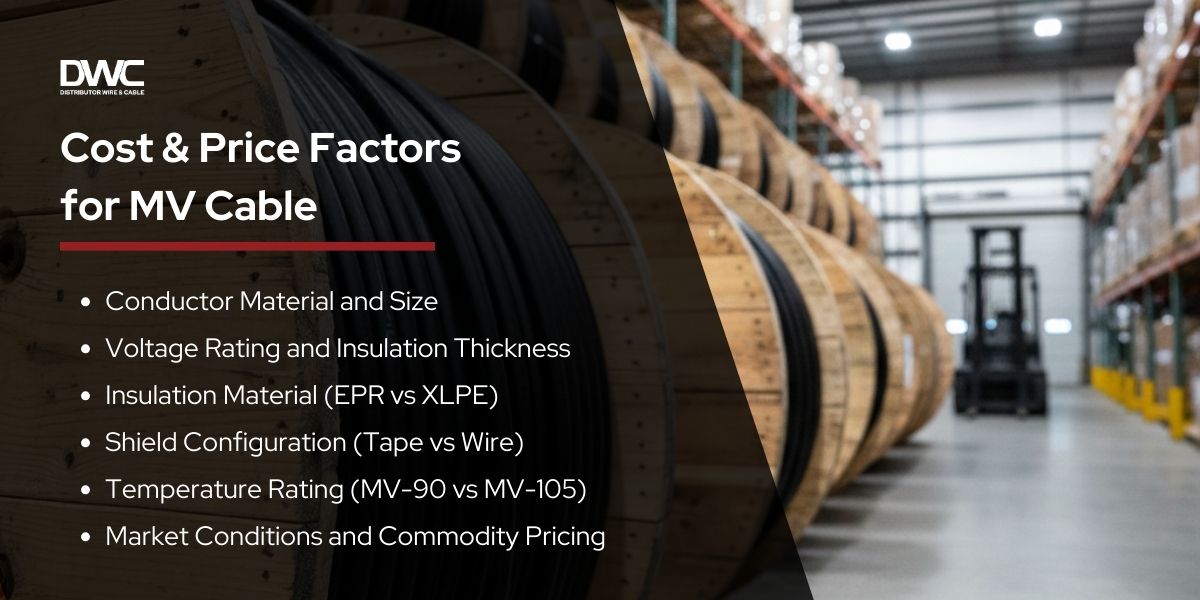
This guide breaks down the six variables that drive medium voltage cable pricing so you can quote with confidence, protect your margin, and position yourself as the technical resource your contractor customers need. Because in a market where data centers are being built at record pace and utility infrastructure is being modernized with federal funding, understanding MV cable pricing isn't just about winning bids. It's about controlling your own profitability.
The Foundation: Understanding What You're Actually Buying
Before we talk dollars per foot, let's establish what medium voltage cable actually is, because this isn't standard building wire. Medium voltage cable refers to any insulated conductor rated between 2,001 volts and 35,000 volts. The vast majority of commercial and industrial projects use cables rated at 5kV, 15kV, or 25kV. Data centers and some utility applications push into 35kV territory.
Every MV cable has four essential components that drive its cost. The conductor (copper or aluminum) carries the current. The insulation layer (EPR or XLPE) provides electrical isolation and determines voltage rating. The shield (copper tape or wire) manages electrical stress and provides a ground path. The jacket protects everything from physical damage and environmental exposure.
The price you pay reflects the material cost of these components, the manufacturing complexity of combining them, and the market dynamics of copper and polymer commodities. When your contractor asks for "15kV cable," they're actually asking for dozens of potential configurations, each with a different price point.
Factor One: Conductor Material and Size (The Biggest Cost Variable)
The conductor accounts for 50 to 70 percent of the total cable cost, which means this is where pricing conversations start. You have two material choices and hundreds of size options.
Copper Conductors: Copper offers superior conductivity, meaning you can push more current through a smaller wire. It's also more flexible and easier for contractors to terminate. The trade-off is cost. Copper is typically two to three times more expensive than aluminum on a per-pound basis, and that gap widens when copper commodities markets spike. A 500 kcmil copper conductor 15kV cable might run anywhere from $28 to $65 per foot depending on insulation type, market conditions, and quantity.
Aluminum Conductors: Aluminum costs significantly less than copper but requires larger wire sizes to carry the same current. This creates a balancing act. The material is cheaper, but you need more of it. For applications where space isn't constrained and ampacity requirements are moderate, aluminum can cut cable costs by 30 to 50 percent. A 500 kcmil aluminum conductor 15kV cable might range from $18 to $42 per foot.
Conductor size follows American Wire Gauge (AWG) for smaller cables and thousands of circular mils (kcmil) for larger ones. Here's where pricing gets exponential. Moving from 2 AWG to 1/0 AWG doesn't just double the price. The copper or aluminum volume increases geometrically, and larger sizes require more complex stranding and manufacturing processes.
Consider these approximate ranges for single conductor 15kV MV-90 cable with copper tape shield:
Conductor Size | Copper Price Range (per ft) | Aluminum Price Range (per ft) |
2 AWG | $5.50 - $12.00 | $3.80 - $8.50 |
1/0 AWG | $7.50 - $16.00 | $5.20 - $11.00 |
250 kcmil | $12.00 - $26.00 | $8.50 - $18.00 |
500 kcmil | $22.00 - $48.00 | $16.00 - $35.00 |
1000 kcmil | $42.00 - $88.00 | $32.00 - $65.00 |
These ranges are a snapshot in time, but give you a general idea of reality. Medium Voltage Cable prices reflect market conditions including material costs, manufacturer pricing, and distributor margins. The low end represents high-volume purchases during stable commodity markets with XLPE insulation. The high end reflects smaller quantities, specialty insulation, or premium configurations.
Factor Two: Voltage Rating and Insulation Thickness
Higher voltage ratings require thicker insulation, which means more material and higher costs. The relationship isn't linear because electrical stress increases exponentially with voltage, requiring disproportionately thicker insulation as you move up the voltage ladder.
5kV and 8kV Cable: These are the entry-level MV ratings, commonly used in building distribution systems, smaller industrial facilities, and some airport lighting applications. The insulation is relatively thin, keeping material costs down. A 2 AWG copper 5kV cable might range from $4.00 to $9.00 per foot depending on insulation type and shield configuration.
15kV Cable: This is the workhorse voltage for medium-sized commercial and industrial projects. The insulation thickness roughly doubles compared to 5kV, adding material cost and manufacturing complexity. The same 2 AWG copper conductor in a 15kV medium voltage rating might jump to $5.50 to $12.00 per foot.
25kV and 35kV Cable: These higher voltages dominate utility distribution, large data centers, and renewable energy installations. The insulation walls are substantially thicker, and manufacturing tolerances are tighter. A 500 kcmil copper 25kV cable could run $32 to $72 per foot, while the same conductor in 35kV might reach $38 to $85 per foot.
The voltage rating also determines the application, which influences urgency and availability. Data centers building critical infrastructure often need 35kV cable immediately, creating market pressure that can push pricing toward the higher end of these ranges.
Factor Three: Insulation Material (EPR vs XLPE)
Once you've determined the voltage rating, you face the EPR versus XLPE decision, and this choice typically adds or subtracts 10 to 20 percent from the cable price.
XLPE (Cross-Linked Polyethylene): This is the budget-friendly option. XLPE costs less to manufacture, offers excellent electrical properties, and handles moisture well. The downside is rigidity. XLPE cable is stiffer, making it harder to pull through conduit and more difficult to terminate in tight spaces. For large utility runs or situations where labor cost isn't a primary concern, XLPE delivers the lowest per-foot price.
EPR (Ethylene Propylene Rubber): EPR costs more, but it buys you flexibility. The cable bends easier, installs faster, and terminates more reliably in challenging environments. For contractors working in existing buildings or complex industrial settings, the 10 to 20 percent EPR premium often pays for itself in reduced labor costs. That 500 kcmil copper 15kV cable that runs $28 to $42 per foot in XLPE might jump to $32 to $50 per foot in EPR.
Most distributors stock both types because different contractors have different preferences based on their installation methods and project requirements. The pricing difference is meaningful but rarely decisive. The contractor's installation environment and termination expertise usually drive the specification.
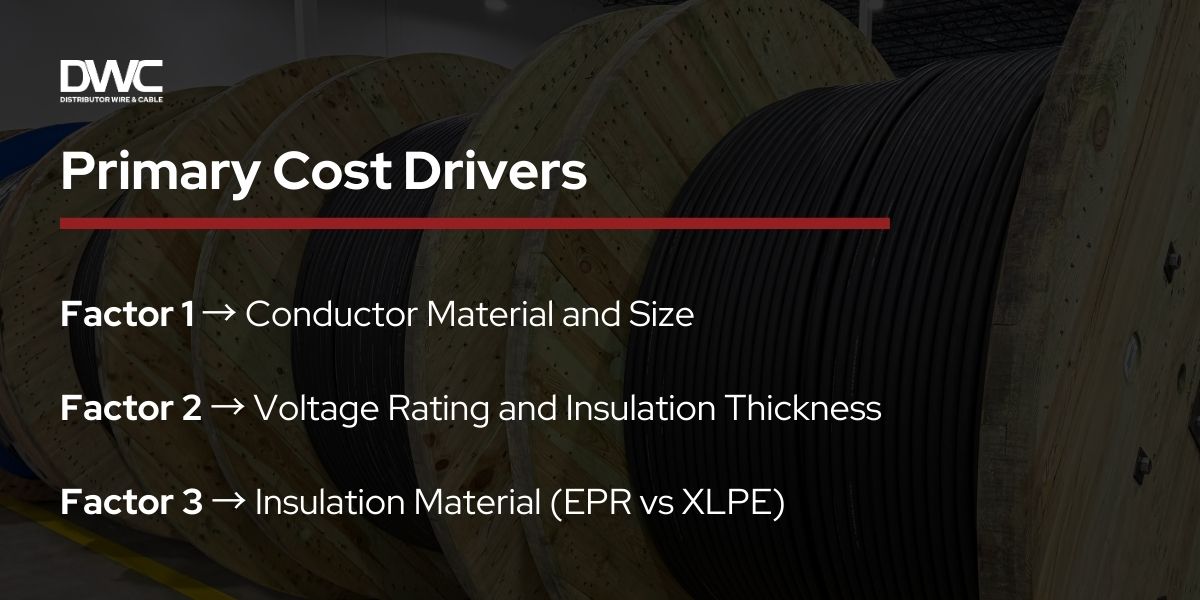
Factor Four: Shield Configuration (Tape vs Wire)
The shield doesn't add as much cost as the conductor or insulation, but it's still a 5 to 15 percent variable that catches inexperienced buyers off guard.
Copper Tape Shield: This is the standard configuration. A helically applied copper tape provides adequate grounding and electrical stress relief for most applications. It's lighter, easier to terminate for routine installations, and costs less to manufacture. The tape shield is the baseline price.
Copper Wire Shield: Wire shield uses individual copper wires spiraled around the insulation layer, providing superior fault current capacity and mechanical strength. It costs more to produce and adds weight, but it's essential for applications with high ground fault currents or installations requiring additional mechanical protection. Wire shield typically adds $1.50 to $6.00 per foot depending on conductor size and voltage rating.
For utility applications, mining operations, or industrial facilities with harsh electrical environments, the wire shield premium is non-negotiable. For standard commercial buildings, tape shield is usually sufficient and more economical.
Factor Five: Temperature Rating (MV-90 vs MV-105)
The temperature rating determines the cable's continuous operating temperature, which directly affects its ampacity (current-carrying capacity). This is where seemingly small price differences unlock significant performance advantages.
MV-90 Cable: Rated for 90°C operation, this is the standard specification for most medium voltage applications. It offers reliable performance at the lowest price point. An MV-90 cable represents the baseline pricing in all the ranges provided earlier.
MV-105 Cable: Rated for 105°C operation, this cable can carry approximately 10 to 15 percent more current than the same conductor size in MV-90 rating. The price premium is typically 8 to 12 percent, but the ampacity gain can allow you to use a smaller conductor size for the same load. A project requiring 400 amps might need 500 kcmil in MV-90 but could potentially use 350 kcmil in MV-105, creating a net cost savings despite the higher per-foot price.
The MV-105 upsell is particularly valuable for data centers and industrial facilities where load growth is anticipated. The extra thermal headroom provides future expansion capacity without replacing cable.
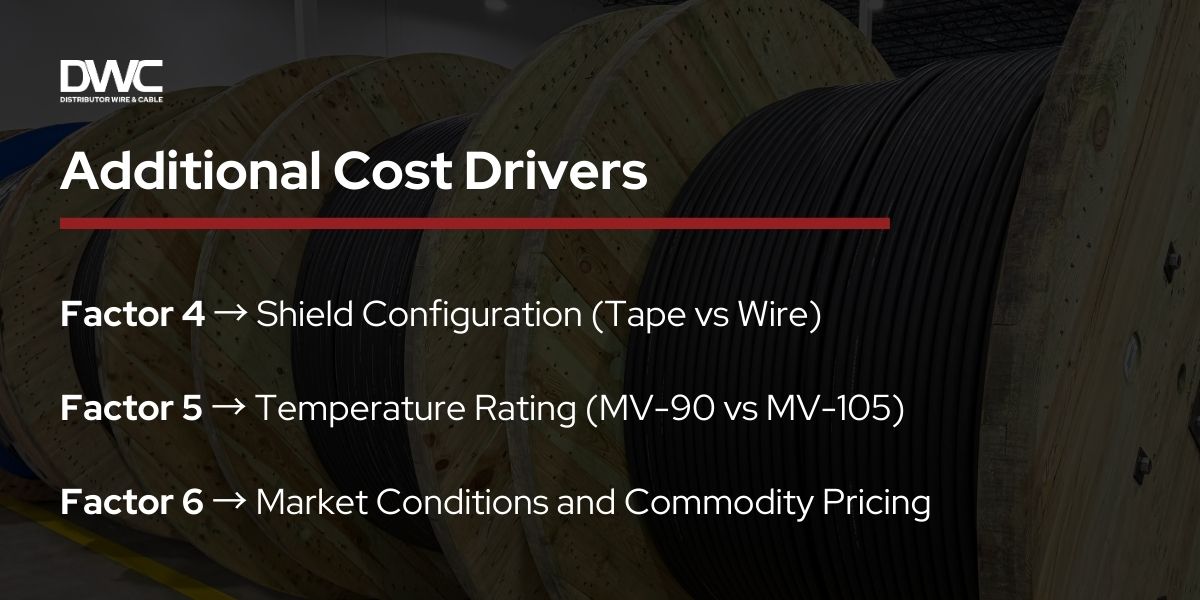
Factor Six: Market Conditions and Commodity Pricing
Here's the factor that keeps distributor buyers up at night: copper and aluminum are commodities with volatile pricing. Unlike wire nuts or conduit fittings that have relatively stable costs, MV cable pricing fluctuates with global metals markets.
Copper prices can swing 20 to 40 percent within a 12-month period based on mining output, global demand (particularly from China and developing economies), and economic conditions. When copper commodities markets spike, manufacturers pass those costs through to distributors within weeks. A cable that cost $32 per foot in January might hit $44 per foot by June without any change in specifications.
Aluminum follows similar patterns but with less volatility since it's more abundant. However, aluminum MV cable isn't immune to price swings, particularly when energy costs rise (aluminum smelting is energy-intensive).
This volatility creates two critical implications for distributors. First, quoted prices have short shelf lives. A quote valid for 30 days might need revision if commodity markets move sharply. Second, strategic stocking relationships with master distributors who absorb some short-term volatility become valuable partnerships rather than transactional vendor relationships.
The "Hidden" Costs That Aren't in the Per-Foot Price
When you compare MV cable quotes, the per-foot price is just the starting point. Several additional charges can add 10 to 30 percent to the total project cost, and different suppliers handle these fees differently.
Cut Charges: Many manufacturers and some distributors charge a fee every time they cut cable from a master reel to your specified length. These charges range from $50 to $200 per cut depending on the cable size and supplier. If you need three different lengths for a project, you could be paying $150 to $600 in cut fees before the cable even ships. This is one area where DWC's no cut charge policy delivers immediate, quantifiable savings. Whether you need 250 feet or seven separate cuts totaling 250 feet, the price remains the same.
Reel Charges: Cable ships on reels, and someone has to pay for those reels. Some suppliers charge $100 to $500 per reel depending on size, with the expectation that you'll return the empty reel for a credit (which rarely happens smoothly). Others build reel costs into the cable price. DWC absorbs reel charges as part of our logistics model, eliminating another line item from your invoice and another headache from your accounting reconciliation.
Minimum Order Quantities: Some suppliers won't cut cable unless you order a minimum footage, often 500 or 1,000 feet. If your project needs 350 feet, you're stuck buying and inventorying the excess or finding another supplier. Master distributors who stock MV cable eliminate MOQs for standard configurations, giving you the flexibility to quote tight quantities without padding the bid.
Freight and Lead Time: Cable is heavy. A 1,000-foot reel of 500 kcmil copper cable weighs over 3,000 pounds. Freight charges can add $200 to $800 to an order depending on distance and delivery requirements. More insidious is the lead time cost. If standard manufacturing lead time is 6 to 8 weeks and your project can't wait, you're either paying expedite fees or losing the bid to a competitor who has stock access. This is where DWC's same-day shipping model shifts from convenience to competitive advantage.
How to Quote MV Cable Without Leaving Money on the Table
Armed with this pricing knowledge, your quoting process should follow a structured approach that protects margin while serving the customer's needs.
Start by gathering complete specifications. Don't accept "I need some 15kV cable" as an adequate project description. Pin down the conductor material and size, voltage rating, insulation type, shield configuration, temperature rating, and total footage. Every missing detail creates an opportunity for the wrong quote.
Use tools like fastQuote to get real-time pricing based on current market conditions and inventory availability. The days of calling three suppliers and waiting for callbacks are over. Modern distributors use digital platforms that provide transparent pricing and immediate availability confirmation.
Consider the total cost, not just the per-foot price. A cable that's $2 per foot cheaper but comes with cut charges, reel fees, and a six-week lead time might actually cost more than a slightly higher-priced option that ships same day with no additional fees. Run the complete project economics, including your contractor's timeline constraints.
Build in appropriate margin based on the service level you're providing. Standard stock items with straightforward specifications might carry lower margins, while emergency orders, custom configurations, or technical consultation services justify premium pricing. Your expertise has value, and distributors who compete solely on price eventually compete themselves out of business.
Why MV Cable Pricing Requires Partnership, Not Just Procurement
The complexity of medium voltage cable pricing explains why successful electrical distributors don't just buy cable. They build relationships with master distributors who understand their markets, stock appropriate inventory, and provide transparent pricing without hidden fees.
When a data center contractor needs 2,000 feet of 35kV cable delivered to a construction site in 48 hours, you're not just supplying wire. You're providing supply chain reliability that keeps a multi-million dollar project on schedule. That service has value beyond the per-foot copper cost.
When a utility contractor calls at 9 PM on a Friday because a storm knocked out a substation and they need 500 feet of 25kV MV-105 cable by Saturday morning, you're not competing with online price shoppers. You're solving an emergency that could leave thousands of people without power through the weekend.
This is why DWC structures our pricing to reflect true market costs without artificial inflation, eliminates the hidden fees that complicate purchasing, and maintains deep inventory across voltage ratings and configurations. The fastQuote platform gives you the pricing transparency you need to quote confidently, while our logistics capabilities give you the speed your customers demand.
The Bottom Line: What MV Cable Actually Costs
If you've made it this far expecting a simple price list, you now understand why that doesn't exist. Medium voltage cable costs anywhere from $3 to $90 per foot depending on the six factors explored in this guide. A small aluminum conductor 5kV cable with XLPE insulation sits at the low end. A large copper conductor 35kV cable with EPR insulation and wire shield hits the high end.
The typical commercial project using 15kV cable with 250 to 500 kcmil copper conductors and EPR insulation falls into the $18 to $55 per foot range depending on specific configuration and market conditions. Data center projects using 35kV cable with large aluminum conductors often land in the $25 to $65 per foot range.
But here's what matters more than these ranges: your ability to quote the right cable for the application, explain the cost variables to your contractor customers, and deliver on time without surprise charges. Contractors don't remember the distributor who was $0.50 per foot cheaper. They remember the distributor who got the spec right, shipped same day, and answered the phone when they had termination questions at the job site.
Ready to Quote Your Next MV Cable Project?
Understanding these pricing factors positions you to quote medium voltage cable with confidence, but nothing replaces real-time pricing for your specific requirements. The fastQuote platform gives you instant access to current pricing based on exact specifications and available inventory.
Whether you're quoting a routine building upgrade or responding to an emergency utility outage, DWC maintains the inventory depth and logistics capabilities to support your medium voltage cable requirements without cut charges, reel fees, or the lead time delays that lose you customers.
Contact your DWC account manager or access fastQuote online to get specification-accurate pricing for your next project. Because in the medium voltage market, the distributor who quotes fastest with complete accuracy usually wins the business, and the distributor who delivers as promised keeps it long-term.