The "Bone Yard" Problem: How Variable-Length SER Cable is Eating Your Margins
Written By: Craig Keller
Posted February 13, 2026

It is 2:00 PM on a Tuesday. A purchase order lands on your desk from one of your steady residential contractor accounts. They are wiring a large custom home renovation and need a main feeder run. Specifically, they need 680 feet of 4/0-4/0-4/0-2/0 aluminum SER cable.
For a purchasing manager, this seemingly simple request triggers immediate mental math. This calculation has nothing to do with the price of aluminum and everything to do with inventory risk. You check your system. You have a standard 1,000-foot master reel sitting in the warehouse.
Here is the dilemma: If you cut that 680 feet to fill the order, you are left with a 320-foot "remnant" on the reel. That 320-foot piece is a financial ghost. It is too short for most main feeder runs in your market, but it is too valuable to simply throw in the scrap bin.
So, you cut the wire, ship the order, and put the 320-foot reel back on the rack. You tell yourself, "We’ll sell that short piece next week." But you know the reality of the wire business better than that. That reel gets pushed to the back. Dust settles on the jacket. Three months later, it’s still there. Six months later, it’s "dead stock."
Eventually, during an end-of-year inventory cleanup, your warehouse manager looks at it and says, "We’re never going to sell this length." It gets stripped and scrapped for pennies on the dollar. When you calculate the original cost of that 320 feet against the profit you made on the 680-foot sale, the math is brutal. You didn’t make a profit on that order; you just broke even, and you tied up warehouse space for six months to do it.
The Economics of "C" Items vs. "A" Items
In the hierarchy of electrical distribution inventory, not all wire is created equal. You have your "A" items—standard THHN building wire, NMB—and your "C" items, like large gauge SER.
When you treat a "C" item like an "A" item by stocking heavy master reels, you expose your branch to significant margin erosion. The profit in the wire and cable game isn't just about the buy/sell spread; it's about inventory turnover and scrap avoidance.
Comparison: "A" Item Inventory vs. "C" Item Inventory
Feature | "A" Items (e.g., THHN, NMB) | "C" Items (e.g., SER, Tray Cable) |
|---|---|---|
Sales Velocity | High (Daily/Weekly) | Low (Project-Specific) |
Length Consistency | Standard/Predictable | Highly Variable (Custom Cuts) |
Scrap Risk | Low (Short ends sell easily) | High (Short ends become dead stock) |
Labor Impact | Minimal (Fast picks) | High (Heavy machinery/Multiple staff) |
Inventory Strategy | Stock Deeply | Buy to Order |
Every day a 300-foot remnant of 2/0 SER sits on your shelf, it costs you money in carrying costs and opportunity cost. That is rack space that could be holding fast-moving products.
Furthermore, there is the labor reality. Large gauge aluminum SER is bulky and heavy. Managing these cuts in-house isn't a one-person job. It requires a forklift, a payout machine, and usually two warehouse associates to measure, cut, and re-spool it safely. If your team spends forty-five minutes wrestling a master reel to get a $400 order out the door, operational costs are eating your gross margin before the truck even leaves the dock.
Flawed Approaches to SER Inventory Management
Most distributors handle this SER problem in one of two ways, neither of which is ideal for the bottom line.
The "Hope Strategy"
This is where the distributor buys the master reels, accepts the risk, and hopes the sales team can push the short ends. This leads to the "Bone Yard"—that corner of the warehouse where odd lengths of cable go to die. We have walked through countless distributor warehouses where thousands of dollars of capital are tied up in 80-foot and 120-foot coils of SER that no contractor wants.
The "Defensive Quote"
To avoid breaking a reel and creating a remnant, the distributor quotes the customer for the full 1,000-foot reel, or prices the cut so high that it covers the risk of the waste. The problem here is competitive pressure. If your competitor is willing to sell the exact length, you lose the order. If you force the contractor to buy the full reel, they remember the inconvenience.
The "Penalty" Sourcing
You find a source who has the cable, but they hit you with a hefty "cut charge" to slice it to length. Suddenly, your margin evaporates, not because of the product cost, but because of the operational fees tacked on top.
Project Consolidation: The Virtual Warehouse Model
The most profitable distributors have realized that for variable-length "C" items like SER, the goal isn't just to find the wire—it's to streamline the logistics. The goal is to say "yes" to the contractor’s exact request without taking on the inventory risk or the labor burden.
This is where Distributor Wire & Cable (DWC) steps in as your operational partner. We have structured our business model to absorb the "short end" risk so you don't have to. But beyond just the cut, we act as a consolidation point for your entire project bill of materials (BOM).
Often, when a contractor needs SER, they aren't just buying SER. They are likely buying a mix of specialty products—perhaps MV-105 for the primary feed or VNTC tray cable for a control system.
If you have the SER in stock, your instinct might be to pull it from your own shelf. But pause and look at the logistics:
Your warehouse team stops to pull your master reel, cut the length, and stage it.
You order the MV-105 and Tray Cable from DWC.
Your receiving department waits for the DWC shipment, marries it with your internal cut, and palletizes it.
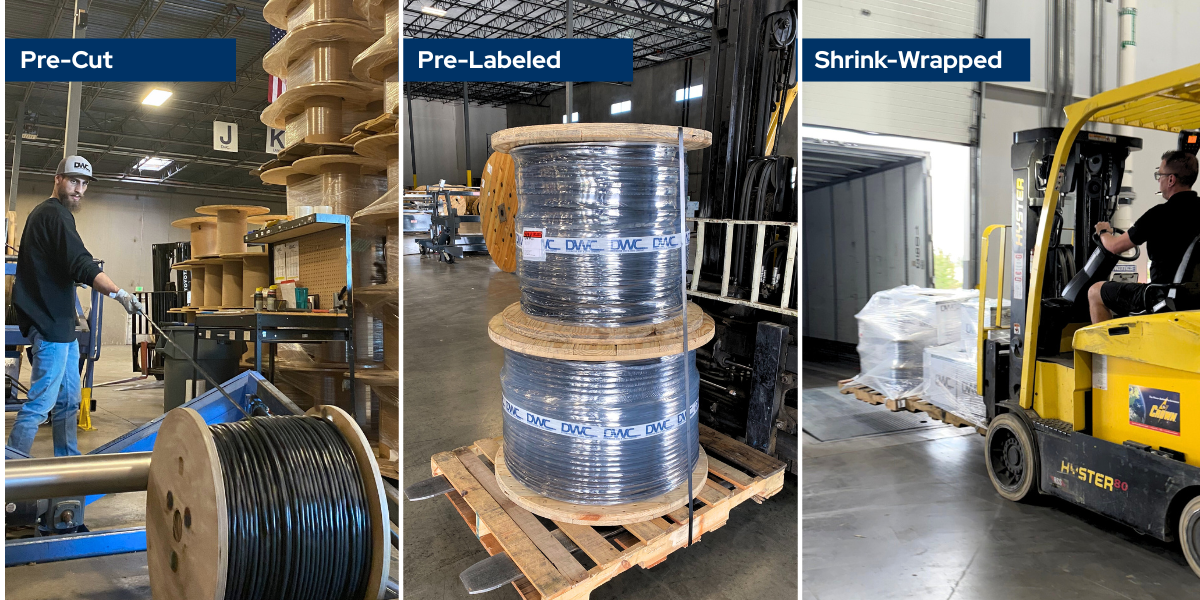
You have introduced a bottleneck. The smarter play is to add the SER to the DWC order. Even if you have it on your shelf, sending the entire specialty list to DWC means the entire order arrives at your dock pre-cut, pre-labeled, and shrink-wrapped on a single pallet.
The DWC Advantage:
No Cut Charges: You pay for the wire, not the labor.
Consolidated Shipping: One PO, one truck, one receiving event.
Zero Scrap: You buy exactly what you sold.
Selling Confidence: The Technical Specs of Aluminum SER
While operational efficiency protects your margin, technical confidence protects your reputation. When your inside sales team is discussing SER cable with a contractor, they need to speak with authority regarding the material and construction.
AA-8000 Series Aluminum Alloy
There is still a lingering "ghost of the past" regarding aluminum wiring from the 1970s. It is important to reinforce that modern SER cable supplied by DWC uses compact stranded conductors made of AA-8000 series aluminum alloy. This is specifically engineered for building wire applications, providing the stability required for modern electrical loads while remaining cost-effective compared to copper.
XHHW-2 Insulation
Our SER features XHHW-2 insulation on the individual conductors. This is a robust, cross-linked polyethylene insulation that offers superior resistance to heat, moisture, and abrasion compared to standard thermoplastic insulation. It is rated for 90°C in both wet and dry locations.
Sunlight Resistant Jacket
The outer jacket is a sunlight-resistant, gray polyvinyl chloride (PVC). This UV resistance is vital because SER is often used to bring power from the meter base (outdoors) to the main distribution panel (indoors). If the jacket degrades under sunlight, the cable fails.
Real World Application: The Garden Apartment Win
Let’s look at how this plays out in the field. A distributor in the Southeast recently landed a project for a garden-style apartment complex. The job consisted of twelve separate buildings, each requiring a main feeder from the transformer pad to the building disconnect.
The Bill of Materials was complex. The contractor needed:
Twelve specific lengths of 4/0 Aluminum SER (ranging from 80 to 315 feet).
500 feet of 600V VNTC Tray Cable for HVAC controls.
A master run of 15kV MV-105 Copper Feeder for the main distribution loop.
The distributor initially considered a piecemeal approach: pull the SER from their own inventory (requiring three different master reels to avoid scrap), buy the MV-105 from a specialty vendor, and source the Tray Cable from a third supplier.
Their operations manager flagged the "Logistics Trap." Sourcing from three places meant three different trucks hitting the dock. Cutting the SER in-house would jam up their cutting station for a full morning, delaying their standard "A" item shipments.
Instead, they sent the entire list to DWC.
"We need these twelve lengths of SER labeled by Building Number, plus the Tray and the MV-105."
DWC processed the order as a Complete Project Kit. We cut the twelve SER runs to the exact specifications and tagged them (e.g., "Bldg 4 - 145'"). We cut the MV-105 and the Tray Cable. We loaded everything onto pallets and shipped it as a single consignment.
When the truck arrived at the distributor, there was no cutting, no measuring, and no waiting. They cross-docked the pallets directly to their delivery flatbed. The financial result? They captured the margin on the entire BOM without incurring the labor costs of processing the wire themselves.
Practical Next Steps for Warehouse Managers
This week, take a walk through your warehouse. Go to the rack where you keep your large-gauge aluminum cable. Look for the short reels—the ones with 100 feet, 180 feet, or 220 feet of cable on them. Ask yourself: How long has that money been sitting there?
If you find yourself looking at a "bone yard" of SER remnants, it is time to rethink how you buy.
But more importantly, look at your next project quote. When a contractor sends over a list that includes SER, Tray Cable, and Medium Voltage, don't just price it line-by-line. Look at the logistics of the list. Does it make sense to fracture that order across multiple vendors and your own warehouse? Or does it make sense to bundle it?
The next time that complex cut sheet hits your desk, call DWC or log into fastQuote. Send us the whole list. Let us manage the master reels, the bandsaws, and the packaging. You focus on being the hero who delivers the complete job, on time and ready to install.