How to Choose the Right Tray Cable: Jacket, Armor, and Conductor Types Explained
Written By: Craig Keller
Posted March 18, 2026

Not all tray cables are created equal. What’s inside and outside the cable matters just as much as where it’s going.
To many buyers, tray cable might seem like a single product: a black-jacketed, multiconductor cable used in industrial control systems. But to the trained eye (and the well-informed distributor), it’s more like a category of cables, each one built for specific performance requirements, environments, and code constraints.
Choosing the right tray cable goes beyond voltage rating or conductor count. It means understanding how insulation materials behave in wet or corrosive environments. It means knowing when a customer needs shielding, or what kind of armor is legally acceptable for an exposed run. And it often means catching what the customer didn’t say out loud—because they may not know the right question to ask.
Distributors who get these calls wrong may face costly returns, failed inspections, or lost business. But those who get them right, the ones who can match spec to scenario or environment to construction, build long-term trust. They become more than a supplier. They become an essential part of the project team.
This guide is designed to help you become that kind of distributor. We’ll walk through the main tray cable construction choices, starting with what’s on the outside: the tray cable jacket.
Tray Cable Jacket Materials: PVC vs. XLP (and beyond)
The outer jacket of a tray cable does more than hold everything together — it’s the cable’s first line of defense against the world. It protects against abrasion, chemicals, UV light, and temperature extremes. It determines whether a cable can be buried, run outdoors, exposed to washdowns, or routed through hot, cramped ceiling trays.
The most common jacket types are PVC and XLP, but understanding their differences is essential if you want to spec correctly. Let’s take a closer look.
PVC (Polyvinyl Chloride): The Familiar Workhorse
PVC is the most common tray cable jacket material, and with good reason. It strikes a balance between performance and affordability, making it ideal for many standard industrial applications.
Cables with PVC jackets offer good mechanical protection and flame resistance. They’re flexible enough for easy pulling and routing through trays or conduits, and they’re widely available in multiconductor, paired, and shielded variants.
But PVC has its limits. It tends to stiffen in cold environments, which can make installation difficult. Its chemical resistance is moderate, so it may not be the best fit for wastewater plants or food and beverage washdown zones. It’s also less tolerant of high heat compared to XLP.
Best for:
Dry indoor environments
Light-to-moderate industrial use
Control panels and conduits with mild temperatures
Budget-conscious applications
What to ask: If a customer is using tray cable indoors, in a non-corrosive, non-wet environment (and isn’t running near motors or heating elements) PVC is often more than sufficient.
XLP (Cross-Linked Polyethylene): Built for Harsh Environments
If PVC is the everyday jacket, XLP is the rugged all-weather upgrade. Cross-linked polyethylene offers superior heat resistance (typically 90°C or higher), outstanding moisture protection, and significantly improved chemical resistance — especially against oils, solvents, and cleaning agents.
XLP’s cross-linking process also reduces dielectric loss, making it ideal for longer runs or sensitive power equipment. It's less flexible than PVC, especially in large conductor sizes, but that stiffness comes with better mechanical integrity over time.
Customers dealing with outdoor installations, washdown zones, or wastewater environments will almost always benefit from XLP-insulated and jacketed tray cable (even if they haven’t explicitly asked for it).
Best for:
Outdoor and exposed runs
Water and wastewater treatment
Industrial washdown or corrosive zones
Applications requiring higher operating temperatures
What to ask: If the job is exposed to water, chemicals, or high ambient heat (or if it runs outside or underground), XLP should be your first recommendation.
Beyond PVC and XLP: Specialized Jacket Options
For certain environments, even XLPE isn’t enough. That’s where specialty jackets like CPE, TPE, and LSZH come in.
CPE (Chlorinated Polyethylene) offers strong flame, oil, and chemical resistance, often used in hazardous locations or where additional UV and abrasion resistance is needed.
TPE (Thermoplastic Elastomer) is highly flexible and chemical resistant, ideal for tight routing spaces, drag chain applications, or cables needing repetitive motion durability.
LSZH (Low Smoke Zero Halogen) is used in data centers, hospitals, and cleanrooms, where limiting toxic smoke and halogen off-gassing during a fire is essential.
These aren’t everyday stocking items, but knowing when to recommend them—especially for government jobs, healthcare, or transit infrastructure- can set you apart from competitors.
Jacket Type | Flame Resistance | Flexibility | Chemical Resistance | UV/Outdoor Rated | Temperature Rating | Cost |
PVC | Good | High | Moderate | Optional | 75–90°C | $ |
XLP | Excellent | Moderate | High | Yes | 90–105°C | $$ |
CPE | Excellent | Moderate | High | Yes | 90°C | $$$ |
TPE | Good | Excellent | Excellent | Yes | 90°C | $$$ |
LSZH | Excellent | Moderate | Moderate | Yes (varies) | 90°C | $$$$ |
Conductor Materials: Bare Copper, Tinned Copper, and Aluminum
We’re not quite at the point where tray cable is woven from room-temperature superconducting graphene-infused nano-bots that auto-route themselves through the ceiling and file for UL approval on the way. Until then, we’ve got copper. And sometimes, aluminum.
While the outside of a tray cable gets a lot of attention (and for good reason), the conductor material inside has just as much to do with how a cable performs, how long it lasts, and whether it actually works in the environment it’s placed in. For distributors, understanding the differences between bare copper, tinned copper, and aluminum isn’t just about price; it’s also about recommending a material that will stand up to the job without standing in the way of an inspection.
Bare Copper: The Industry Standard
Bare copper is the default conductor in most tray cable. It’s a highly conductive, readily available, and well-understood material that plays nicely with a wide range of terminations, grounding methods, and code requirements. It’s the go-to choice for dry, indoor environments, control panels, and most tray or conduit installations where corrosion is not a significant concern.
Is it a downside? In wet, humid, or chemically active environments, bare copper can oxidize over time, potentially leading to resistance build-up, corrosion at terminations, and long-term reliability issues. It’s not fragile — but it’s not invincible either.
Best used in:
Dry, enclosed spaces
Conduit and tray install with minimal exposure
Standard industrial automation environments
Red flag question: “Will this be exposed to moisture, condensation, or chemicals?” If the answer is yes, it’s time to move up the materials chain.
Tinned Copper: The Unsung Hero of Wet and Corrosive Environments
Tinned copper is essentially bare copper with a thin layer of tin electroplated onto each strand. That tiny addition makes a big difference. The tin layer acts as a corrosion barrier, preventing oxidation in wet, humid, or chemically active environments, and extending the life of the cable, especially at the termination points, where exposure is most likely.
Tinned copper is also a smart move in marine, wastewater, and outdoor applications, and it's frequently required in food and beverage processing due to constant washdowns. It's slightly more expensive than bare copper, but many contractors are willing to pay the premium for peace of mind.
Best used in:
Water treatment facilities
Food processing and beverage plants
Outdoor installations in humid or coastal regions
Anywhere you expect washdowns, spray, or condensation
Distributor tip: If the environment is wet and you quote bare copper by default, you’re not doing your customer a favor; you’re setting them up for early cable failure.
Aluminum: Lightweight, Cost-Effective, and Sometimes Overlooked
Aluminum conductors are far less common in control and signal cables but play a real role in power tray cable, especially in large-gauge, long-run applications. Why? Because aluminum is lighter and cheaper than copper, it matters when you're wiring hundreds of feet across rooftops or between distribution panels in large buildings or renewable energy sites.
The trade-off is conductivity. Aluminum isn’t as conductive as copper, so cables must be upsized to carry the same current. It’s also more susceptible to creep (loosening at terminations over time), and it requires AL-rated lugs and terminations to avoid galvanic corrosion when mixed with copper systems.
That said, for customers in solar, battery energy storage, or data centers, aluminum tray cable can be a smart and cost-effective solution if it's engineered correctly.
Best used in:
Utility-scale solar or battery energy systems (BESS)
Long industrial power runs where weight/cost are key concerns
Environments where labor savings from lighter cable matter
What to clarify: Ask your customer, “Are you pulling this yourself or hiring it out?” Some crews aren’t familiar with aluminum best practices—and they need to know it requires careful torque and termination methods.
In short, while copper remains king in most tray cable applications, choosing the right flavor of conductor (bare, tinned, or aluminum) can make or break a project’s performance over time. And the more you understand the real-world consequences of each, the better advice you’ll give.
Shielding: Shielded vs. Unshielded Tray Cable
Not every tray cable needs shielding. But when it does, you really don’t want to get it wrong, because few things derail a job faster than unpredictable electrical interference.
As a distributor, you don’t have to be an RF engineer to give good guidance. But you do need to understand what shielding is, what it does, when it’s necessary, and how it impacts cost, flexibility, and installation. For more information about Tray Cable to further round out your understanding, read our ultimate guide to tray cable.
Shielding isn’t just a technical preference — it’s a decision that directly affects system performance, especially in electrically noisy environments like factories, data centers, and water treatment plants.
What Is Shielding And Why Does It Matter?
At its core, shielding is a barrier. Shielding is a conductive layer built into the tray cable that protects the inner conductors from electromagnetic interference (EMI) and radio frequency interference (RFI). It’s not about the electricity flowing through the cable — it’s about protecting the signal from what's going on around the cable.
Think of it like insulation for your audio system. Without shielding, outside electrical noise can leak in and distort the signal. The stakes are even higher in industrial environments, where interference doesn’t just cause static but can also trigger false signals, misfiring relays, nuisance shutdowns, or full-on system failures.
Shielding is especially important for:
Low-voltage signal cables (e.g., sensor loops, 4-20mA controls)
Analog instrumentation (e.g., RTDs, flow meters)
Control circuits in high-EMI environments (near motors, switchgear, VFDs)
When an unshielded cable runs through a noisy environment (such as in a tray next to a VFD or alongside motor leads), it can act like an antenna, picking up interference and carrying it straight into the control system.
A Real-World Problem: The Mystery Shutdown
One of our distributor partners shared this all-too-familiar story. Their contractor customer had installed unshielded tray cable in a food processing facility to run signals from a series of stainless steel washdown sensors back to the main control panel. Everything seemed fine until the packaging line started shutting down intermittently and without warning.
The contractor spent days troubleshooting. Motors were scoped, PLCs reprogrammed, even replacement sensors were installed. Still, the system failed.
Eventually, after the contractor looped in our distributor partner, they retraced the wiring layout and realized the signal cables were running in the same tray (and in some places zip-tied) directly next to several variable frequency drives powering conveyors. The VFDs were generating high-frequency electrical noise, and the unshielded control cable was soaking it up like a sponge.
The fix? We helped the distributor quickly source and ship foil/braid shielded TC cable, pre-cut and labeled to spec. The contractor swapped the cable in the worst sections first, and the shutdowns stopped immediately.
The contractor not only won back the plant manager’s trust, but the distributor earned a follow-up blanket order for upcoming lines. Why? Because when the stakes were high, they didn’t just guess — they understood the why behind the wire.
The Lesson for Distributors buying Tray
This is the kind of knowledge that separates a quote from a solution.
You don’t need to know how VFDs generate harmonics or what kilohertz range the noise is in. But you do need to recognize when a system is susceptible to EMI, and when your customer might be unintentionally cutting corners by skipping shielding.
Shielding doesn’t always add significant cost. But skipping it? That can cost your customer thousands in rework, labor, downtime, and strained customer relationships. The installer might not blame the wire—but you can bet they’ll remember who sold it.
Unshielded Tray Cable: Simpler, Cheaper, But Use with Caution
Unshielded tray cables (often labeled simply as TC or TC-ER) are perfectly acceptable for power distribution, simple control signals, and any environment where EMI is not a major concern. They’re easier to terminate, more flexible, and typically cost less than their shielded counterparts.
This makes them the default choice for:
Lighting control
Motor power runs (with proper separation)
HVAC relays
Indoor conduit work with no interference sources
But here’s the risk: if that unshielded cable ends up routed near high-frequency or high-voltage sources (like VFDs or switchgear) it can become an antenna for electrical noise. And if the system starts behaving unpredictably, no one remembers the cable… until it’s the last thing left to blame.
Key question to ask: “Is this cable going near VFDs, drives, or large motors?” If the answer is yes, you probably need shielding.
Shielded Tray Cable: Control, Clarity, and Compliance
As we discussed earlier, shielded tray cable includes an additional conductive layer, typically made of aluminum foil, braided copper, or both, which is wrapped around the conductors. This layer is connected to the ground via a drain wire and acts as a barrier against external interference. Some shielded cables are even designed to reduce emissions as well as absorb them, which is important in sensitive environments like laboratories or hospitals.
There are three main types of shielding:
Foil Shield (100% coverage)
Lightweight, easy to terminate
Excellent for high-frequency noise rejection
Common in signal and control cables
Braid Shield (typically 85–90% coverage)
Durable, flexible, better for low-frequency noise
Handles mechanical stress better (good for motion or vibration)
Combo (Foil + Braid)
Best of both worlds for maximum EMI protection
Often used in harsh EMI environments like wastewater plants, heavy industry, or near VFD banks
Distributor Tip: Not all shields are created equal. If your customer is using a VFD cable, make sure it’s shielded with a full coverage braid or foil braid and not just a light-duty foil meant for analog signals.
When to Recommend Shielded Cable (Even If the Customer Doesn’t Ask)
Let’s be honest: many contractors don’t know (or don’t think to ask) about shielding. It’s up to you to read between the lines of the job spec and ask the right questions:
“Will this be near motors or drives?”
“Is this for a PLC or sensor loop?”
“Are you seeing issues with false signals or trips?”
If the answer to any of those is yes (or even “I think so”), then offering a shielded alternative could save your customer days of frustration and rework.
And here’s the kicker: shielded tray cable doesn’t have to be dramatically more expensive. In many cases, it’s a small premium compared to the labor cost of troubleshooting a noisy system. Helping your customer see that is where your value as a distributor really shows.
Cable Layouts: Multiconductor, Paired, and Triads
When most people look at a tray cable spec, their eyes jump straight to the gauge and conductor count “12 AWG, 7C” and stop there. But what those conductors are doing inside the cable matters just as much as how many there are. The way they’re laid out: whether bundled as a group, organized into pairs, or grouped in threes (triads) directly impacts how the cable performs, how it's terminated, and whether it protects or jeopardizes signal integrity in real-world systems.
Let’s break down the three most common layout types and why they exist.
Multiconductor (Cables with 2+ Conductors Bundled Together)
This is the standard, “default” tray cable layout. Two, three, four, or more conductors, each with its own insulation, are bundled inside a single overall jacket. These cables can carry power or control signals and are easy to route and terminate.
When to use multiconductor:
Powering motors or heaters
Running start/stop switches or basic on/off control circuits
Wiring to light fixtures or contactors
They’re cost-effective and widely available, but there’s a catch: signal isolation is minimal. When you have multiple conductors bundled together, voltage spikes, noise, or harmonics on one can be coupled into the others. That’s not a problem when you’re controlling a motor contactor, but it’s a big issue when you’re running a low-level analog signal alongside 120V control power.
Distributor perspective: If your customer says, “It’s just low-voltage stuff,” ask what else is in the tray. Multiconductor may work, but paired or shielded layouts may be safer if power and signal are in close quarters.
Paired Cable (Twisted Pairs for Signal Isolation)
In a paired-tray cable, conductors are twisted into dedicated pairs—usually with color-coded insulation—and sometimes individually shielded. These pairs are then bundled together under a common jacket.
This isn’t just about organization — it’s physics.
Twisting the pair cancels out electrical noise, much like noise-canceling headphones. Each wire in the pair picks up the same external interference (but in opposite phase) so the noise cancels itself out at the receiving end. This is known as common-mode rejection, and it’s critical in environments with EMI, long cable runs, or sensitive analog signals.
When to use a paired cable:
4–20 mA analog instrumentation loops
Sensor wiring
Serial communication (Modbus, RS-485, Profibus)
Distributed I/O connections
Some cables go a step further and include individual shields around each pair for maximum isolation, plus an overall shield. These are often found in process control or building automation systems.
Real-world scenario: A brewery contractor needs to wire pressure sensors back to a control panel, and the run crosses a tray full of motor leads. If you sell them multiconductor cables, their signals will likely get noisy. If you sell them individually, shielded pairs? The system stays rock-solid, the contractor looks like a genius, and you just became their favorite distributor.
Tray Cable Triads (Three Conductors Twisted Together)
Less common but critical in certain control applications, triad cable twists three conductors into a group—typically used for powering and signaling transducers or 3-wire instrumentation loops.
In some systems, especially in older DCS and analog infrastructure, transducers use a 3-wire connection: positive, negative, and ground or shield return. Triads keep these wires together, balanced, and protected from external interference—especially when combined with shielding.
When to use triad cable:
Process control and instrumentation
Older refinery or water treatment plant systems
3-phase sensor or control signal applications
Pro tip: If your customer says “transducer loop” or is replacing a sensor cable in a water plant or refinery, ask if the old cable was triad. It often is—and swapping in multiconductor or a random-pair cable can throw the system off entirely.
Choosing the Right Tray Cable Layout: It’s About the Job, Not Just the Cable
You don’t need to memorize every permutation of layout options. What you do need is a mindset:
Is the customer running power, control, or signal?
Are the signals analog (4–20mA) or digital (on/off)?
Will this run near EMI sources like VFDs or generators?
Is cable routing long, shared with power, or outdoors?
When in doubt, layout matters more than price. And it’s always better to over spec a little—especially with signal cables—than to try and save a few cents per foot and risk a callback.
Armoring Options for Tray Cable: When and Why It Matters
The thing about armor is, it’s rarely about armor. It’s about what’s expected to go wrong.
That’s what guys in the field are really solving, not just mechanical protection or crush ratings. They’re asking: What happens when the forklift drifts too close? When does the tray run stops short? When does the inspector shows up early and wants to see every inch of exposed cable documented and defensible?
That’s where armored tray cable steps into not as a fancy feature, but as a simple answer to a question no one wants to ask too late.
We didn’t always have options. Before armor was integrated into tray cable, you ran conduit. Period. You bent the pipe, strapped it every 10 feet, pulled your THHN, and hoped the pull lube didn’t gum up in the summer. It was labor-intensive, stiff, overkill for most installs—but code said do it, so you did it.
Then came the shift.
Somewhere in the late ‘60s and early ‘70s, the electrical industry—especially in Canada and parts of the American rust belt—started seeing cable constructions built not just to carry current, but to survive. You had massive industrial builds going up fast—pulp mills, mines, chemical plants—places where you couldn’t afford to re-pull cable because someone backed a lift into a tray. They needed a cable that could take a hit and keep running.
Armoring isn’t just about ruggedness; it’s about compliance, cost, protection, and installation realities. Whether or not a tray cable needs armor depends on three main factors:
Physical risk – Will the cable be exposed to impact, abrasion, rodents, or movement?
Code – Will it be used in a hazardous location, or does it require mechanical protection outside the tray?
Jobsite conditions – Is conduit a hassle to install or maintain?
Tray cable can be unarmored, have interlocked armor, or—especially in Canadian projects—use TECK90 constructions. Let’s walk through each option so you can guide the customer toward the right call for their project.
Unarmored Tray Cable: The Standard Choice, But Not for Every Job
Most tray cable is unarmored—and in many cases, that’s completely fine. When installed in a protected cable tray, inside a building or conduit, and away from physical hazards, there’s no reason to add unnecessary weight or cost.
Unarmored TC or TC-ER is easy to cut, strip, and terminate. It’s also more flexible, which can matter in tight panel spaces or ceiling trays with turns.
When it works:
Indoor installations in clean, dry, protected locations
Conduit runs where the conduit itself provides physical protection
Projects where weight and bend radius are concerns
When it doesn’t:
If the cable exits the tray in a mechanical area and isn’t TC-ER rated
If local AHJs (Authorities Having Jurisdiction) require protection outside conduit
If the job is in a Class I Div 2 zone without proper environmental control
Pro insight: TC-ER rating lets you run cable exposed for up to 6 feet from the tray to the equipment without armor, as long as it’s supported and not subject to damage. But if the customer exceeds that distance—or can’t physically support the cable—you’re in armor territory.
Tray Cable With Interlocked Armor: Conduit-Free Protection That Saves Time
Interlocked Armor took off in the States as a way to ditch conduit in commercial and light industrial environments. Instead of running EMT, you wrapped the cable in a helix of aluminum or galvanized steel and called it a day. It gave just enough protection to pass code—without slowing you down. You could snake it through ceilings, run it down mechanical chases, drop into RTUs without bending a stick of pipe.
It provides mechanical protection equivalent to conduit, while still being flexible and relatively easy to install.
Think of it as a “built-in conduit” that travels with the cable. Interlocked armor is a metallic helically wrapped layer (usually aluminum or galvanized steel) applied over the cable core and under the outer jacket so contractors don’t need to pull wire, bend pipe, install straps, or file inspections on separate runs. That’s a huge labor and materials win.
When to recommend it:
Indoor mechanical rooms with exposed cable runs
Drop ceilings where conduit is expensive or impractical
Facilities that require frequent equipment changes
Temporary or modular installations where conduit would be wasteful
Common applications:
Schools, hospitals, and light commercial buildings
Clean industrial plants
Data centers or backup generator wiring
What to check:
Some AHJs still prefer conduit in specific zones—check local code if in doubt
Make sure terminations are compatible with armored cable (requires specific fittings)
Real-world moment: A contractor in Atlanta was running TC-ER from a cable tray to a VFD bank in a food processing plant. The facility required washdown-rated armored cable for exposed zones over production. We helped the distributor pivot to interlocked armor with a CPE jacket, saving the job from delay and letting them skip 200 feet of rigid EMT conduit. The contractor finished a day ahead of schedule—and sent the distributor his next job spec two weeks later.
TECK90: The Canadian Armored King
In Ontario, around Teck Township, mining engineers started specifying a rugged, jacketed armored tray cable that could survive outdoor burial, corrosive air, impact, and fire—without needing pipe. It became what we now call TECK90. CSA certified. Class I Div 2. Water-blocked. Drag it across gravel and bury it if you have to. It was ugly, but it worked. And it still does.
TECK90 is a special armored tray cable and it's widely used in Canadian construction and industrial environments, given its success, its increasingly found in U.S. border projects or multinational specs.
It combines:
XLP insulation for wet/corrosive environments
An interlocked aluminum armor layer
A full PVC jacket for flame, oil, and chemical resistance
TECK90 is rated for hazardous locations, direct burial, and outdoor use.
It's often specified for:
Oil and gas projects
Water/wastewater treatment plants
Grain handling or food processing
Refineries and chemical facilities
Important notes for U.S. distributors:
It may not be recognized by all U.S. AHJs—double-check NEC compliance
TECK90 requires specialty fittings to seal properly
It’s bulkier and heavier—advise your customers to plan for bend radius and tray fill
Choosing Tray Cable Armor: It’s a Code Call, But Also a Contractor Call
We know distributors who’ve saved customers entire days of labor just by saying, “Have you considered interlocked armored tray cable instead of building a raceway?” That kind of recommendation doesn’t just save money. It earns trust.
A customer in Tulsa once told us his customer's crew cut install time by 30% just switching from THHN in pipe to interlocked TC-ER with an outdoor-rated jacket. No conduit, no inspection delays, no fighting bends on a scissor lift. He got out early, under budget, and picked up two change orders. You think he called the same distributor on the next job? Absolutely!
Armor, when it’s chosen with intent, isn’t a product spec. It’s a jobsite shortcut that still gets you across the finish line clean.
The real question for distributors isn’t “Do you stock armor?” It’s “Do you know when not having it will get your customer burned?”
Because if you do, and you say something—before the job gets red-tagged or the tray gets crushed—you’re not just filling a PO. That's *real* support. And they won’t forget that.
As a distributor, you won’t always know how rough the install environment is. But the right questions go a long way:
Will the cable be exposed to forklifts, vibration, or impact?
Does the inspector allow TC-ER without conduit or armor?
Is conduit install time a problem?
If yes, any of those, offer armored tray cable as an option—even if it’s not on the BOM (Bill of Materials). You’ll save the customer time and likely prevent an expensive rework down the line.
Putting It All Together: Matching Tray Cable Specs to the Real World
Knowing the difference between PVC and XLP, or between shielded pairs and triads, is one thing. But applying that knowledge in the field—when a contractor calls from the road or sends over a BOM with missing context—is where it actually counts.
This section is about making those decisions easier.
Not every distributor has the time to analyze every variable in a cable spec. But with a few key questions and a solid understanding of use cases, it becomes much easier to recommend the right tray cable—or suggest a better one than what’s on the sheet.
Let’s walk through the kinds of questions that lead to good recommendations, along with some example scenarios.
Ask the Right Questions
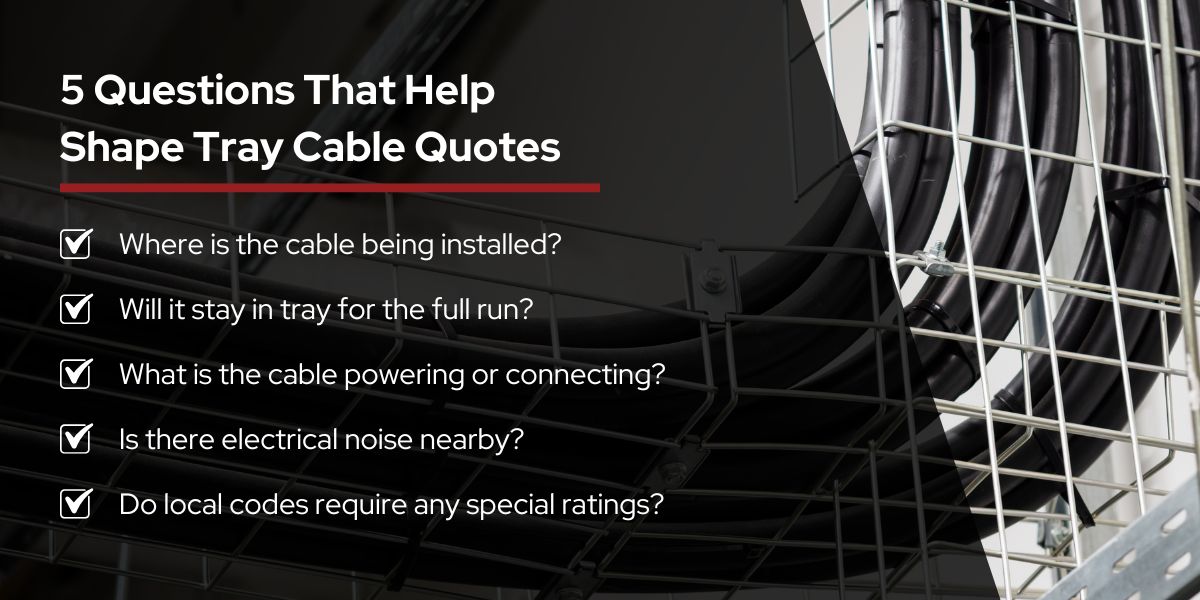
When a customer requests “tray cable,” get curious. These five questions can help guide nearly every quote:
Where is this tray cable being installed? Indoor, outdoor, buried, overhead, exposed to water or chemicals?
Is it running in tray the entire way or exiting to connect equipment? If it's exposed beyond the tray, is it TC-ER or does it need armor?
What is the cable powering or connecting? Motors, PLCs, sensors, lighting, VFDs, instrumentation?
Is there electrical noise nearby? If so, shielding or twisted pairs/triads may be needed.
Do local codes require any special ratings? This includes hazardous location approvals (TC-ER-HL), FT4 flame ratings, or CSA/UL dual listings.
Three Real-World Scenarios
Scenario 1: Small Industrial Plant Expansion
A contractor is adding control wiring to new mixers and conveyors in a food processing facility. They ask for “12/4 tray cable.”
You ask where it’s going and learn it will run from the tray to the equipment—partially exposed, with washdowns twice a week.
Recommendation: 12 AWG, 4C, TC-ER with an XLPE jacket, sunlight and wet location rated. Possibly tinned copper conductors for corrosion protection. Shielding is not required since it’s basic control, and no drives are nearby.
This avoids overengineering but still covers the environmental risks.
Scenario 2: VFD Retrofit in a Municipal Water Plant
A customer requests “shielded 14/3 tray cable” to connect new VFDs to pump motors.
You confirm the cable will be in a shared tray with other power and control cables, and the motors are outdoors.
Recommendation: 14 AWG, 3C, VFD-rated tray cable with foil + braid shielding, XLP insulation, and sunlight-resistant armor if run exposed. Suggest tinned copper conductors for moisture protection.
In this case, ordinary shielded cable would likely fail or cause system errors—this helps prevent downtime and ensures compliance.
Scenario 3: Rooftop Unit Wiring for a Retail Chain
An electrical contractor needs to connect RTUs across the roof of a big box store. They originally spec’d THHN in conduit but are open to faster options.
You ask whether the inspector allows exposed runs, and find out that the conduit plan is a labor-driven choice, not a code requirement.
Recommendation: Pre-cut lengths of interlocked armored tray cable, sized to match conductor and voltage requirements. Armor eliminates the need for pipe, passes inspection, and significantly reduces labor.
This is a case where recommending an alternate cable spec unlocks speed, savings, and goodwill.
Consider Creating a Go-To Reference
Many distributors benefit from having a go-to matrix of common tray cable types matched to environments, usage, and regulatory needs. Something like:
Environment | Recommended Jacket | Insulation | Conductor | Shielding | Armor/Rating |
Indoor, clean, dry | PVC | XLP | Bare Copper | Unshielded | Standard TC |
Wet/chemical areas | PVC | XLP | Tinned Copper | Optional (add shielding near VFDs) | Sun-Res/Direct Burial |
Outdoors, exposed | PVC (Sun-Res) | XLP | Bare or Tinned | Unshielded | TC-ER or Armor |
Near EMI/VFDs | PVC | XLP | Bare or Tinned | Foil + Braid Shielding | Specialized VFD Tray |
Hazardous locations (Div 1/2) | PVC | XLP w/HL Rating | Tinned Copper | Shielded (per spec) | MC-HL or TECK90 |
Even a simplified version on the counter or inside sales desk can help reps have more confident conversations, especially when quoting under pressure.
Download the printable type: asset-hyperlink id: JK7tceYiVY0ds72raxdhH to keep at your desk.
Be the Guide Your Customers Count On
Choosing the right tray cable isn't about memorizing part numbers. It's about understanding what the job demands, what the code requires, and what the contractor may not be thinking to ask. When you guide your customers toward the right spec—whether that means recommending shielding for a VFD run or suggesting interlocked armor instead of pulling pipe—you’re not just selling cable. You’re helping them avoid rework, protect their margins, and win more business.
That’s the kind of support contractors remember. It’s also the kind of distributor DWC exists to support.
Why Work with DWC?
As a master distributor of specialty wire and cable, DWC was built to help you say yes when the stakes are high and the details matter. We’re not here to push products; we’re here to equip you with the expertise, flexibility, and responsiveness that sets you apart from commodity competitors.
When you work with DWC, you get:
Fast, custom cuts on a huge range of tray cable types—including shielded, armored, and TC-ER
Access to hard-to-find specs and custom builds other suppliers won’t touch
Real human support from a team that understands code, application, and contractor realities
FastQuote, our rapid quoting tool built for the way you actually work
Whether you're supporting a national account or helping a contractor get out of a pinch, we're behind you — not in front of your customer and never competing with your sale.
Let’s make tray cable your advantage.
Work with DWC and deliver more than cable. Deliver confidence.
Get a fastQuote or talk to our team about your next tray cable order.