Compliance Confidence: How to Read a Tray Cable Spec and Know It'll Pass Inspection
Written By: Craig Keller
Posted March 16, 2026

In the industrial wire and cable world, compliance isn’t optional. It's the difference between a smooth sign-off and a costly jobsite shutdown. A tray cable that doesn’t meet spec doesn’t just cause inconvenience—it can cost your contractor customer thousands in rework, delay final commissioning, and erode the trust they place in your branch.
But here’s the truth: this happens every day. A contractor pulls what they thought was standard TC-ER for an exposed run, only to find the jacket lacks the "Exposed Run" designation. Or worse—someone tries to run VW-1-rated control cable in a cable tray system, only to get flagged during inspection for lack of IEEE 1202 flame test compliance.
As job specs get more technical and contractors place more pressure on distributors for support, the ability to confidently read a jacket print and spec sheet isn’t a nice-to-have—it’s a core skill.
This guide will walk you through:
How to read the markings printed directly on a tray cable
How to cross-check spec sheets against code requirements
What to verify before quoting so your customer passes inspection the first time
For distributors who quote or sell tray cable, this is the kind of knowledge that turns a one-off transaction into a lasting partnership. And if you’re ever looking at a complex spec and aren't sure? DWC is here to be your technical backstop, helping you verify the details before you quote.
Anatomy of a Tray Cable Jacket Marking
A tray cable’s jacket is more than a protective layer; it’s the paper trail of compliance. Every marking tells a story about how that cable is built, what environments it’s rated for, and whether it can legally be used in the application your contractor is quoting.
Let’s break down a typical tray cable jacket marking:
12 AWG 3C TC-ER-JP SUN RES DIR BUR 600V 90C DRY / 75C WET UL 1277
Marking Element | What It Means |
|---|---|
12 AWG 3C | This is the wire gauge and conductor count: 12-gauge, 3-conductor. It sets expectations for ampacity and voltage drop. |
TC-ER-JP | “TC” means Tray Cable, listed under UL 1277. “ER” (Exposed Run) means it meets UL’s crush and impact tests and can legally run up to 6 feet outside the tray—without conduit. “JP” (Jacketed Power) is a manufacturing term indicating this is a multiconductor jacketed cable, as opposed to paired or triad constructions. |
SUN RES | Sunlight resistant. This is critical for any outdoor or rooftop install. Without it, UV degradation can cause jacket cracking and insulation failure. |
DIR BUR | Direct burial approved. Means the cable is watertight and jacketed for underground use—without additional conduit. |
600V | Voltage rating. Some low-voltage controls may only require 300V, but 600V-rated tray cable is the standard for industrial power and control. |
90C DRY / 75C WET | Operating temperature ratings. This helps ensure the cable can be used in high-heat spaces like mechanical rooms or ceiling trays, while still compliant in wet locations like wastewater plants. |
UL 1277 | UL listing number for tray cable. UL 1277 confirms that the cable meets construction and performance requirements for flame resistance, insulation, and environmental durability. |
These markings are your first line of defense against quoting the wrong cable—and your customer’s best protection against a red tag on the jobsite.
What if the tray cable's jacket marking is missing or illegible?
In older stock, cut remnants, or sun-faded reels, jacket markings may be worn or hard to read. If you're not sure:
Request the original spec sheet or UL file from the manufacturer or master distributor.
Avoid guessing. Code compliance is not a place to assume.
Contact DWC. We’ll help you verify whether a reel or partial order meets spec before it goes out the door.
How to Cross-Check a Spec Sheet Against Code Requirements
Reading the jacket is a great first step, but to confirm whether a cable meets all code and inspection requirements, you'll need to take a closer look at the spec sheet. Here's what to verify:
Flame Ratings
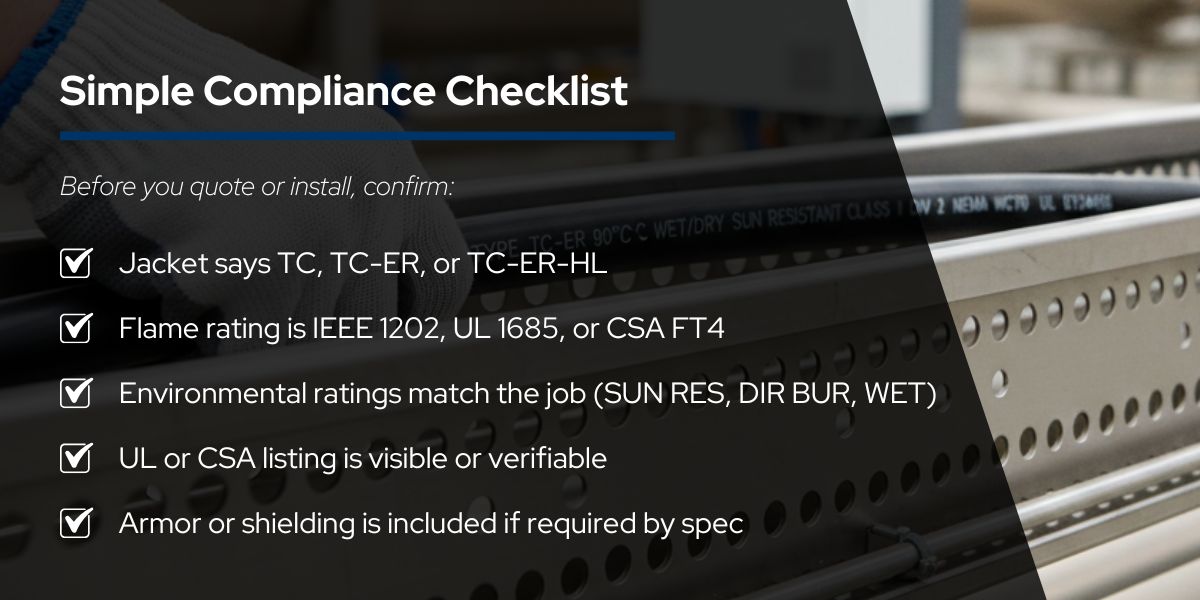
IEEE 1202 / UL 1685: Required for tray cable used in cable tray systems where multiple conductors are bundled. This test ensures flame propagation is limited in the event of a fire.
CSA FT4: The Canadian equivalent, often found on dual-listed cables.
VW-1: A lower-level flame rating that’s not sufficient for tray installations under NEC.
If it’s going in a tray, IEEE 1202 or UL 1685 should be the baseline. If the spec only lists VW-1, that’s a red flag.
Environmental Ratings
Sunlight Resistant: Required for any outdoor use. Look for “SUN RES” or equivalent on the jacket and in the spec sheet.
Direct Burial: Indicates the cable is jacketed and sealed for underground installs. If not explicitly rated, burial without a conduit may violate the code.
Wet Location Use: Verify temperature ratings (e.g., “75°C wet”) and confirm conductor insulation is suitable for constant moisture exposure.
Mechanical Construction Details
Jacket material (PVC, XLPE, CPE) determines chemical resistance and suitability for harsh environments.
Armor (interlocked, TECK90) is critical if the cable will be exposed in mechanical areas or hazardous locations.
Shielding (foil, braid) matters for installations near VFDs or EMI sources, especially in control and instrumentation circuits.
Flame Ratings Demystified: What IEEE 1202 / UL 1685 Really Test
If you’ve ever watched a cable tray go up in flames during a live burn test, you’ll never forget it.
The IEEE 1202 / UL 1685 Vertical Tray Flame Test isn’t just a checkbox on a spec sheet; it’s a real-world safety measure that determines whether a cable will contain a fire or contribute to one. For inspectors and engineers, this rating is non-negotiable. For contractors and distributors, it’s often misunderstood. Or worse, overlooked.
Here’s what the IEEE 1202 (also known as UL 1685) test actually involves:
A 70,000 BTU/hour burner is directed at a vertical tray filled with bundled cable.
The burner runs for 20 continuous minutes.
To pass, the flame must not propagate more than 8 feet up the tray.
This simulates a worst-case scenario: if something sparks or overheats in a cable tray, what happens next? A compliant cable will self-extinguish. A non-compliant cable could act like a fuse, and in an industrial environment, that’s a disaster waiting to happen.
This test is a far cry from the VW-1 (Vertical Wire) flame test that’s often misunderstood as equivalent. VW-1 only tests a single vertical conductor with a much smaller flame source and shorter burn time. It’s fine for machine tool wire or appliance cable, not for bundled tray runs. Similarly, CSA FT4, the Canadian equivalent of 1202, tests multiple conductors in a cable tray—but again, specifics vary slightly between standards.
So, when does it matter?
If your customer is installing cable in any significant tray system—especially where cables are bundled, unarmored, or run vertically—IEEE 1202 or UL 1685 is the expectation. Anything less risks inspection failure, insurance issues, or worse.
A Cautionary Story
One of our distributor customers recently got a call from a contractor in a bind. A 30,000 sq ft processing facility was nearly ready for inspection. The job spec had clearly called for IEEE 1202 flame-rated tray cable, but somewhere along the way, the contractor subbed in VW-1-rated signal cable “because it looked the same.” It wasn’t. The inspector caught it, and nearly 600 feet of installed cable had to be pulled and replaced at the contractor's expense.
That’s not just lost margin. That’s lost time, lost trust, and a hard-earned reputation on the line.
Pro Insight: If it’s going in a tray, and you’re running more than a few feet, IEEE 1202 is your default expectation. Anything less is a gamble.
NEC References Made Simple: What 336, 392, and 501/502 Actually Mean
Most people don’t read the National Electrical Code (NEC) for fun. That’s not a criticism; it’s a reality of the time constraints at the counter. But if you sell tray cable, knowing the gist of a few key NEC articles can save you and your contractor customers a world of trouble.
Think of these codes not as red tape, but as the "rulebook of permissions." If you know the rules, you can help your customer find the most efficient path to a finished job. Let’s break down the ones that matter most:
Article 336: Tray Cable (Type TC)
This is your foundation. Article 336 defines what tray cable is, where it can be used, and under what conditions it qualifies for exposed run (ER) applications.
The TC-ER designation, for example, isn’t just a manufacturing term. It’s a code-defined permission. If your customer is running cable outside of the tray, they need it to be TC-ER, and it must be properly supported and protected.
Article 392: Cable Tray Systems
This article governs the installation of cable tray systems themselves. It addresses spacing, fill capacity, support requirements, and structural standards. It also specifies which cable types are permitted in the tray—meaning, if your cable isn’t listed as TC under UL 1277, it doesn’t belong there.
This is the article inspectors often reference when they ask about flame ratings—because 392 assumes flame-propagation-tested cable is being used.
Articles 501 and 502: Hazardous Locations
If the project touches Class I Division 1 or Division 2 spaces—refineries, grain elevators, wastewater digesters—Article 501 or 502 applies. This is where TC-ER-HL comes in.
For a tray cable to be used in hazardous locations, it must:
Pass additional tests under UL 2225
Be listed specifically for HL applications
Be terminated using appropriate sealed glands and fittings
Many distributors think TC-ER is enough. It’s not. If the jacket doesn’t say “HL” and the spec sheet doesn’t back it up, the cable can’t go in a classified area. No exceptions.
Quick Reference: NEC Articles
What It Covers | What to Look For on Cable/Spec Sheet | |
|---|---|---|
336 | Tray Cable usage & exposed runs | Marking: TC, TC-ER; UL 1277 listing |
392 | Cable tray system installation | Flame rating (IEEE 1202), bundle spacing, support data |
501/502 | Hazardous locations (Div 1 & 2) | HL rating; UL 2225 listing; proper fittings required |
Common Failure Points in Tray Cable and How to Prevent Them
Let’s be honest: most inspection failures related to tray cable aren’t caused by bad cable. They’re caused by overlooking the fine print. Here are five of the most common reasons tray cable fails inspection and how to avoid them:
Missing TC-ER marking on an exposed run
The cable might be fine electrically, but if it's not marked TC-ER, it’s not approved for that exposed span from tray to motor.
Using VW-1 rated cable in tray systems
Flame test misunderstanding is rampant. VW-1 ≠ IEEE 1202. If the job calls for a bunding in a tray, don’t settle for anything less than 1202 or UL 1685.
No sunlight resistance on rooftop installations
UV damage is real. Cable jackets that aren’t rated for sunlight exposure can crack, degrade, and fail—even in under a year.
Non-armored cable in mechanical or wet locations
Some job sites require additional mechanical protection or sealed armor for compliance. That means interlocked armor or TECK90, not just standard TC.
Unlisted or imported cable without proper documentation
It may look the part, but if the UL listing isn’t valid, inspectors won’t pass it. Be wary of unknown brands or undocumented cable.
Red Flag Rule of Thumb:
If the cable is going to be:
Buried
Exposed
Outdoors
In a hazardous location
Then the markings and listing better prove it can handle that environment. If it doesn’t say it on the jacket or it’s not in the UL file, it doesn’t count.
Building Tray Cable Compliance Knowledge on Your Team
Knowing how to read a jacket marking or spec sheet shouldn’t be a "specialty skill" that lives with just one veteran at the back desk. When every person on your team—from the warehouse to the outside sales rep—understands the basics of tray cable compliance, it becomes a massive competitive advantage for your branch.
When your team can spot a missing "ER" rating or flag a VW-1 discrepancy before the PO is even cut, they aren't just selling wire. They are protecting the branch’s margins and the contractor’s schedule. And the best part? It doesn’t take a four-hour seminar to build this capability. It starts with a few simple, operational habits:
Brown bag trainings once a month. Review a real cable spec and walk through where it’s rated, where it’s not, and what jobs it’s suited for.
Start a “bad label” folder. Collect photos of unlabeled or unclear cable jackets. Keep them visible at the counter or in a shared team folder. Use them to ask: “What would we do if this showed up?”
Turn every inspection fail into a learning opportunity. If a customer brings back a failed install, make sure your team knows why it happened—and how to spot it next time.
Create a quick-reference NEC sheet. List the most common articles (336, 392, 501) and what markings to look for. Post it at the counter or quote desk.
The more your team can confidently answer questions like, “Can this run exposed?” or “Is this rated for Class I Div 2?”, the more your customers will start treating you like a partner—not just a place to buy cable.
And, of course, if you want to continue to expand the knowledge that you and your team have around Tray Cable, you could always just keep coming back to the
Distributor Wire & Cable KnowledgeHub
that you're reading right now!Confidence Comes from Clarity When It Comes To Tray Cable
Tray cable compliance isn’t something to fear; it’s something to master. When you understand what the jacket markings mean, how to verify a spec sheet, and which NEC codes apply to the jobsite, you become more than a vendor. You become the guide who helps your contractor customers avoid costly mistakes and navigate complex projects with confidence.
That knowledge builds trust. And in the specialty cable world, that trust is what builds your business. Whether you’re quoting a rooftop VFD install, a wastewater retrofit, or a hazardous location run in a refinery, your ability to say, “Yes, this will pass inspection and here’s why,” is what sets your branch apart from the competition.
Let DWC Help You Quote, Cut, and Comply with Confidence
We built DWC to make tray cable easier to stock, specify, and deliver, without sacrificing speed or certainty.
Need to confirm a flame rating? We’ll check it. Not sure if it’s TC-ER-HL or just TC-ER? We’ll verify before you quote. Looking for cut-to-length cable with all the right markings? We've got it on the floor, ready to ship.
Looking to learn more about tray cable? We wrote the Ultimate Guide to Tray Cable! You should check it out!
You don’t have to know everything. You just need a partner who does.
Distributors: Don't let a complex spec slow down your counter. Get a 24-hour quote on standard specialty tray cable and let our team help you verify the details before you ship. Contact us today.