SOOW vs SJOOW vs SEOOW: What the Letters Tell You
Written By: Craig Keller
Posted July 30, 2026

A contractor calls and asks for 250 ft of SO cord. You have SOOW on the rack. Can you ship it, or do you owe them a callback?
That question lands at the counter every week, and the answer is sitting right there in the letters. S, J, O, E, W. None of them are marketing. Each one is a specific construction detail that a manufacturer had to build to and a lab had to verify.
Once you can read them, most substitution calls answer themselves while the customer is still on the phone. Here is what each letter means, how SOOW, SJOOW, and SEOOW differ from one another, and which requests you can fill straight from stock.
What SOOW stands for
Four parts, and you can read them straight off the jacket. S is a service cord rated 600V for extra-hard usage. The first O tells you the jacket resists oil. The second O tells you the insulation underneath it resists oil too. W means weather and water rated, which is what puts it outdoors.
So: 600V, oil resistant inside and out, built to work outside.
DWC stocks SOOW from 18 AWG through 2 AWG. Stranded bare copper, thermoplastic elastomer insulation, CPE jacket, rated 600V and 90°C, suitable for shallow to medium water immersion, and MSHA approved for hard usage.
The letter system, one letter at a time
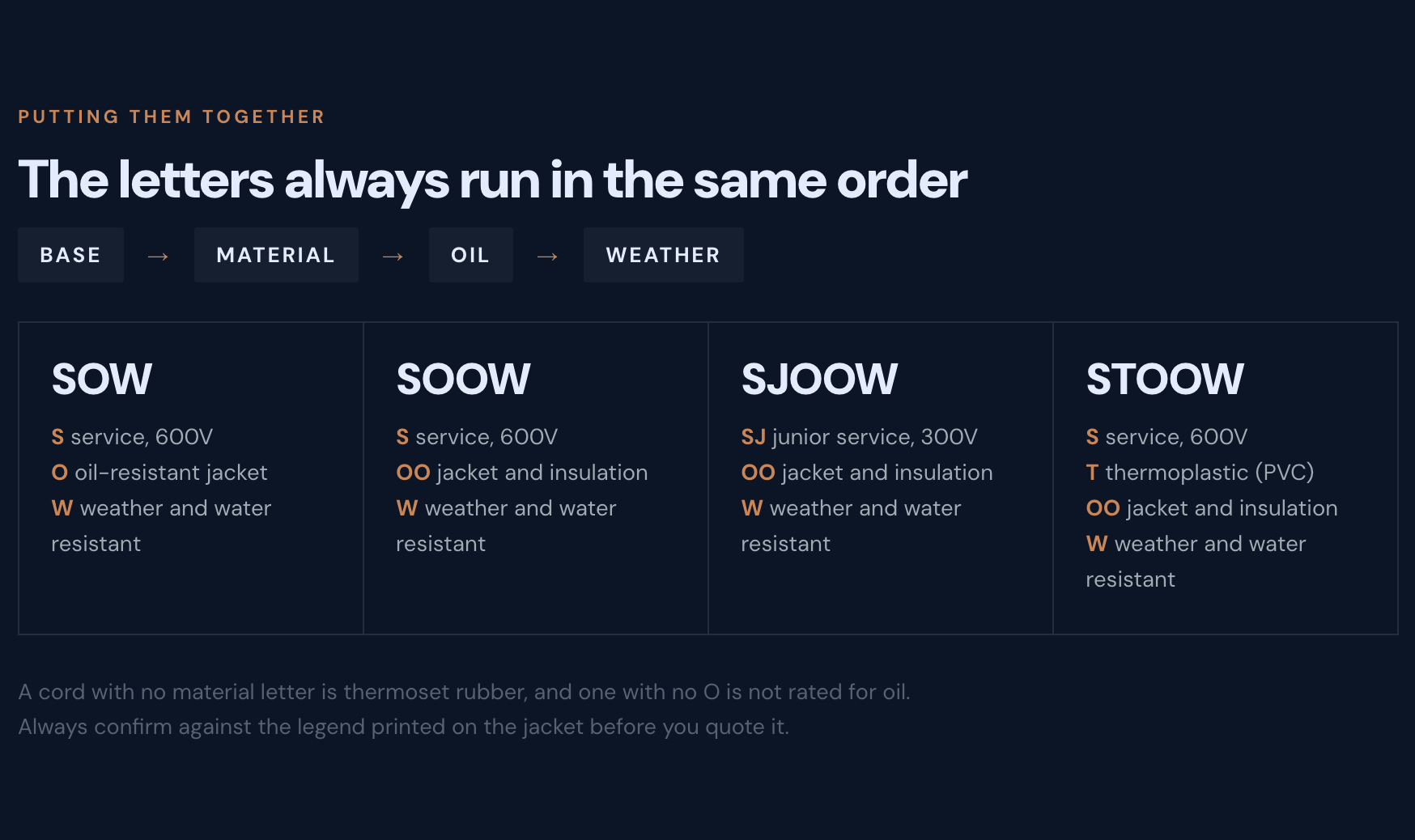
Every designation in the flexible cord family gets assembled from the same short list of letters.
Letter | What it means | What it changes |
|---|---|---|
S | Service cord, 600V, extra-hard usage | The heavy end of the flexible cord family |
SJ | Junior service cord, 300V, hard usage | Thinner, lighter, and a different voltage class |
O | Oil-resistant jacket | Handles oil on the outside |
OO | Oil-resistant jacket and insulation | Handles oil that gets past a damaged jacket |
W | Weather and water resistant | Approved for outdoor use |
E | Thermoplastic elastomer | A wider temperature range than standard rubber |
T | Thermoplastic (PVC) | A different jacket family altogether |
No suffix | Thermoset rubber | The base construction |
Read it left to right and the designation spells itself out. SJOOW is a junior service cord, oil resistant on both layers, weather rated. SEOOW is the same 600V cord as SOOW built out of thermoplastic elastomer instead of rubber.
And these are not one manufacturer's naming scheme. Table 400.4 of the National Electrical Code lists the types, and UL 62 governs how they get built. When a submittal or a spec sheet calls out a designation, that is where it came from, which is also why an engineer is unlikely to bend on it.
Why two O's matter more than one
One O covers the jacket. Two O's put oil resistance on the insulation as well.
You find out which one your customer bought the first time a jacket takes a gouge on a rough edge. On a single-O cord, oil reaches insulation that was never built to handle it, and the cord starts failing from the inside where nobody can see it. On OO construction there is a second layer in the way.
That is most of the reason OO exists, and it is why almost anything running through a machine shop, a processing plant, or a facility with hydraulics on the floor gets specified that way.
SOOW vs SJOOW: the 300-volt line
One difference changes the electrical answer, and it is voltage. SOOW is 600V. SJOOW is 300V. S is extra-hard usage, SJ is hard usage, and the J stands for junior.
Everything else is nearly identical. Both run 90°C. Both use stranded bare copper with thermoplastic elastomer insulation and a CPE jacket. Both stand up to solvents, oils, flame, and moisture.
The difference that shows up on the job is size. SJOOW is thinner, lighter, and easier to handle, and that is usually why somebody specified it in the first place. It has to feed through a particular cord grip, wind onto a particular reel, or land in a strain relief sized to its outside diameter.
Which is what makes the swap tricky in the other direction. If a customer asks for SJOOW and you send SOOW, you have given them more voltage rating than they need, and electrically that is fine. You have also given them a fatter, stiffer cord that may not fit the hardware the job was built around. Call before you ship that one.
SJOOW color code, for what it is worth at the counter: black and white on two conductors, black, white, and green on three, black, white, red, and green on four.
SOOW vs SEOOW: when 90°C is not enough
The E is thermoplastic elastomer, and it buys you two things SOOW cannot. A 105°C rating at the top end, and a jacket that stays flexible when it is cold enough to crack a standard cord.
Everything else matches. Both are 600V, both are oil resistant on the insulation and the jacket, both are weather rated.
SOOW | SEOOW | |
|---|---|---|
Voltage | 600V | 600V |
Temperature | 90°C | 105°C |
Conductor | Stranded bare copper | Extra flexible bare copper |
Insulation | Thermoplastic elastomer | Thermoplastic elastomer |
Jacket | CPE | Thermoplastic elastomer, multiple colors |
Standard color | Black | High-grade yellow |
Notes | MSHA approved for hard usage | MSHA approved. Power sizes 8 AWG and larger are non-UL |
Your customer may not ask for SEOOW by name. Plenty of them will ask for the yellow SO cord, because yellow is the standard SEOOW jacket and that is what came off the truck on the last job. So when somebody describes a freezer room, an outdoor shutdown in February, or a line running hot, they want SEOOW whether they said the word or not.
But watch the UL listing. In SEOOW power sizes, 8 AWG and larger, the product is non-UL. If the spec calls for a listing at those sizes, raise it before the reel ships rather than after.
What SOOW cord is used for
SOOW goes wherever equipment needs power and the cord has to move with it. Industrial and processing equipment, cranes and hoists, motor connections, and anything asking for flexibility plus resistance to solvents, oils, flame, and moisture. It handles shallow to medium water immersion.
Temporary power on an active jobsite is the one you will quote most. Construction, maintenance shutdowns, emergency setups, and anything else where the power has to be there Monday and gone in six weeks.
What SOOW will not do is replace fixed wiring. Flexible cord cannot run through walls or ceilings, cannot be concealed behind building surfaces, and cannot substitute for a permanent wiring method. If a customer starts describing a run that sounds permanent, that is a conduit and building wire job, and the sooner you say so the less likely it comes back as a failed inspection. The complete portable cord and mining cable guide walks through the NEC Article 400 and Article 590 rules that decide where flexible cord is permitted.
What to ask before you quote it
Most callbacks on portable cord trace to a question nobody asked up front. Five of them cover almost everything.
Is any of it outdoors? If yes, you need the W. This is the one that quietly kills a substitution you were about to make.
How hot or how cold does it get? Standard SOOW is 90°C. If the answer involves a freezer, a furnace, a February shutdown, or a motor housing, you are looking at SEOOW.
What is it landing in? Cord grips, strain reliefs, and molded plugs are sized to a specific outside diameter. This is what decides whether you can stand SOOW in for SJOOW.
Is it going in the water, and how deep? Shallow to medium immersion is covered. Continuous submersion is a different product, and you want to know that before you quote it.
Does the spec require a UL listing? Ask this early on anything 8 AWG and larger, because that is exactly where SEOOW is non-UL.
And if the job is a mine site, that changes what you are selling. MSHA acceptance is not the same thing as a UL listing, and the two get used interchangeably by people who should know the difference.
Reading the print on the jacket
When a customer calls about a reel already sitting in their yard, you do not have to guess. The answer is printed on the cord.
Portable cord is surface printed at intervals with the type designation, the conductor size and count, the voltage rating, and the temperature rating, along with the listing marks. Have them walk down the jacket until they hit it and read it back to you. That beats guessing from the color, and it beats trusting whatever somebody wrote on the tag three jobs ago.
It is also the fastest way to settle an argument about whether what is on site matches what got submitted.
The substitution table
Keep this one near the phone. It assumes what you can pull from DWC stock: SOOW in 18 AWG through 2 AWG, SJOOW, and SEOOW.
Customer asks for | What it means | Can you cover it |
|---|---|---|
SO | 600V, oil-resistant jacket, no weather rating | Yes. SOOW meets it and adds oil-resistant insulation plus the weather rating |
SOW | 600V, oil-resistant jacket, weather rated | Yes. SOOW adds oil-resistant insulation |
SOOW | 600V, oil resistance both layers, weather rated | Yes, 18 AWG through 2 AWG |
SJO or SJOW | 300V junior service | Yes. SJOOW meets it and adds oil-resistant insulation |
SJOOW, and only SOOW on hand | 300V junior service | Electrically yes, at a higher rating. But SOOW is thicker and stiffer and may not fit the cord grip or plug. Confirm first |
SOOW, but it runs hot or cold | Past 90°C, or cold enough to stiffen a standard jacket | Go to SEOOW at 105°C. Check the UL requirement at 8 AWG and up |
ST, STO, or STOW | Thermoplastic PVC construction | No. Different jacket family, and DWC does not stock it |
SOOW larger than 2 AWG | Past the top of the SOOW range | No. Type W picks up from 1/0 through 500 MCM at 2kV |
A single flexible conductor | Not a multi-conductor cord at all | Welding cable at 600V, or DLO at 2kV |
Two things to keep in mind before you swap anything. An upgraded cord still has to satisfy the spec as written, so on a spec-driven job the engineer or the AHJ gets the last word no matter how good your substitution looks on paper. And a bigger cord can pass on every rating and still fail on fit.
Where portable cord stops and mining cable starts
Above 2 AWG and above 600V you are out of the S family and into mining cable.
Type W is a 2kV portable and mining cord built on extra-flexible bare copper with EPDM insulation and a CPE jacket, MSHA approved, available as a single conductor and as multi-conductor from 1/0 through 500 MCM. It is what most customers mean when they say two-kay cord.
Type G and GG-C are 2kV cords for three-phase systems that need grounding conductors. Type G carries four insulated grounds. GG-C carries two grounds plus a reduced ground check, which is the one to reach for when the equipment monitors ground continuity.
SHD-GC at 5kV is shielded trailing cable, and it runs behind continuous miners, dredges, loaders, and drills.
When a request carries the word approved, pin down which approval they mean. MSHA splits cable approval across two parts of 30 CFR, and knowing which one applies settles the compliance question on the first call instead of the third. For listing requirements more generally, see cable certifications explained.
SOOW cord FAQs
What does SOOW stand for?
S is a 600V service cord rated for extra-hard usage. The first O is an oil-resistant jacket, the second O is oil-resistant insulation, and W is the weather and water rating that allows it outdoors.
Is SOOW the same as SO cord?
No. SO has an oil-resistant jacket only and no weather rating. SOOW adds oil-resistant insulation and the outdoor rating, so it meets or exceeds SO on every count.
What is the difference between SOOW and SJOOW?
Voltage class. SOOW is 600V extra-hard usage, SJOOW is 300V junior service rated for hard usage. SJOOW is also thinner and more flexible, which affects what hardware it fits.
Can SOOW be used outdoors?
Yes. The W is the weather and water rating, and it is what makes the cord acceptable outside.
Can SOOW be submerged?
DWC's SOOW handles shallow to medium water immersion. Continuous submersion is a different requirement and needs checking against the spec.
What voltage is SOOW rated for?
600V, at 90°C.
Is SOOW oil resistant?
On both layers. Jacket and insulation, which is what the double O tells you.
Can I use SOOW instead of building wire?
No. Flexible cord cannot replace a fixed wiring method or run concealed in walls, ceilings, or floors.
What replaces SOOW above 2 AWG?
Type W, a 2kV MSHA-approved portable and mining cord available from 1/0 through 500 MCM.
The letters exist so nobody has to guess, and reading them takes about as long as reading this sentence. The harder part is the follow-up question, and that usually comes down to asking where the cord is going and what it plugs into.
Need a number on portable cord or mining cable? Send it through fastQuote and get a quote back in about six minutes, cut to the length the job needs, with no cut charges and no reel minimums.