Portable Cord and Mining Cable: The Complete Distributor's Guide
Written By: Elyza Castillo
Posted June 8, 2026

Portable cord and mining cable can be a profitable category for electrical distributors, but it is not always straightforward to quote. Contractor requests often come in using field terms like “two-kay mining cord,” “trailing cable,” “yellow jacket,” or “welding lead.” Those names are familiar in the field, but they do not always map one-to-one with formal cable designations.
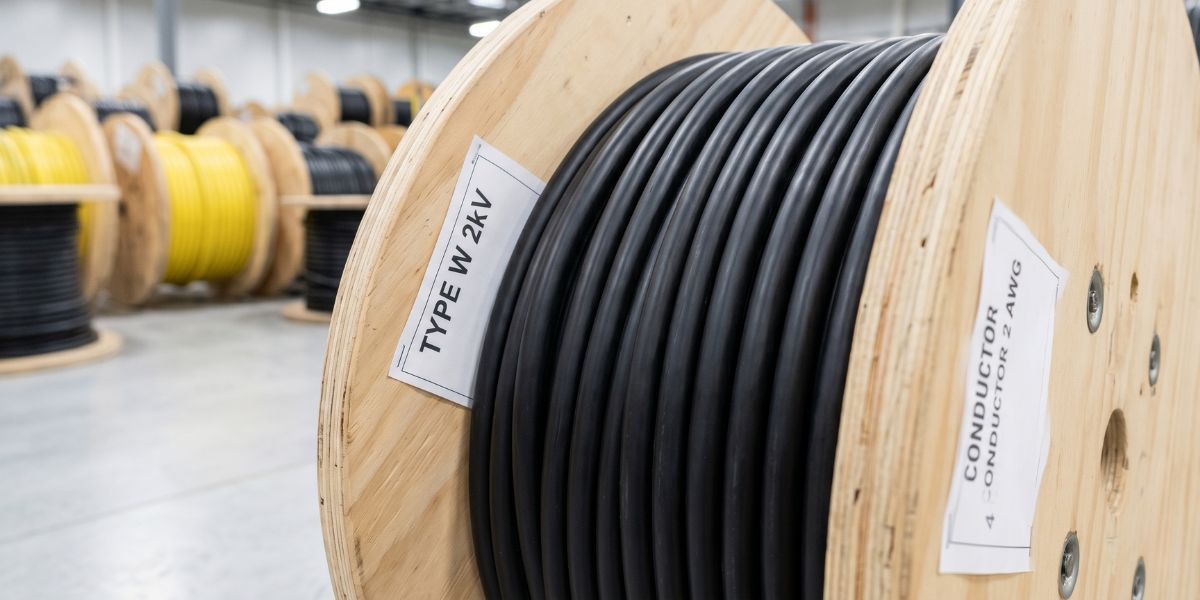
That distinction matters because products in this category can differ by voltage class, conductor count, ground configuration, shielding, jacket construction, and approval requirements. Type W, Type G, GG-C, SHD-GC, DLO, SOOW, and SEOOW may all show up in similar quoting conversations, but they are not interchangeable.
This field guide covers the major product types, common field terms, relevant standards, voltage classes, and sourcing considerations that can make the category a stronger margin line.
What Portable Cord and Mining Cable Covers
Portable cord and mining cable covers a wide family of flexible, jacketed cable products built to move, flex, and withstand conditions that fixed wiring is not designed to handle. These cables may be dragged across concrete, coiled on reels, dropped from crane hoists, immersed in shallow water, or pulled behind continuous miners in underground operations. The construction reflects those demands: extra-flexible stranded copper conductors, elastomeric insulation, and tough thermoset or thermoplastic jackets that resist oil, ozone, abrasion, and a wide range of chemical exposure.
The category spans a variety of end markets, including underground mining, oilfield service, construction, crane and hoist applications, marine shore power, stage and entertainment, rental fleets, and substation work. Each market brings its own field terminology, standards requirements, and quoting considerations. For distributors, that range creates opportunities beyond the basic 600V cord family.
Product complexity starts with the type designations. Letters matter, numbers matter, and the word “approved” matters. Type W, Type G, and GG-C are all 2kV portable cords used in heavy industrial service, but the construction differs across the three. A request for “trailing cable” usually points to SHD-GC. “Yellow jacket” usually points to SEOOW. “Welding lead” points to Welding Cable. For a deeper look at how jacket compounds influence cable behavior across this category, see our breakdown of cable jackets vs. insulation.
The Standards Stack
A compliance question from a contractor, safety officer, or project engineer usually points to a specific code, listing, regulatory, or construction reference. Identifying which reference applies keeps the quote tied to the right requirement.
NEC Article 400: Flexible Cords and Cables
NEC Article 400 covers flexible cords and flexible cables, specifically the construction, identification, permitted uses, prohibited uses, ampacity ratings, protection from physical damage, securing and supporting, and connection methods. This is the code reference behind every SO, SOOW, SJOOW, and SEOOW conversation. The article also requires that flexible cords and cables comply with UL 62 (Flexible Cords and Cables) and UL 817 (Cord Sets and Power-Supply Cords).
NEC Table 400.4 is where the actual cord types get identified. The table lists every standard cord designation along with its voltage rating, construction, and usage category. Examples a customer will reference directly from Table 400.4:
Cord Type | Voltage | Usage Category |
|---|---|---|
SOOW | 600V | Extra-hard usage |
SJOOW | 300V | Hard usage (junior service) |
SEOOW | 600V | Extra-hard usage |
SJEOOW | 300V | Hard usage (junior service) |
STOW | 600V | Extra-hard usage (thermoplastic) |
Type W | 2,000V | Extra-hard usage, mining-grade |
The hard usage vs. extra-hard usage distinction is a real construction difference. Cords with the letter S as the leading designation (S, SO, SOOW, STOW, SEOOW) are for extra-hard usage. Cords with SJ as the leading designation (SJ, SJO, SJOOW, SJTOW, SJEOOW) are junior service cords rated for hard usage. SJOOW and SOOW are different products at different usage ratings. A spec calling for extra-hard usage at 600V is specifying SOOW or an equivalent S-prefix cord, not the SJ family.
One question that comes up at the counter is whether flexible cord can be used as a permanent wiring substitute. Per NEC 400.12, it cannot. Flexible cord is not a substitute for fixed building wiring and cannot be concealed behind building surfaces. SOOW is permitted for the portable and temporary applications listed in Article 400 and Article 590. THHN in conduit is the product for fixed building wiring.
NEC Article 590: Temporary Installations
NEC Article 590 covers temporary electric power and lighting installations, including construction, remodeling, maintenance, repair, demolition, emergencies, tests, and decorative lighting. This is the article that applies when the application is wiring a construction site, a maintenance shutdown, an emergency setup, or a holiday lighting installation. It covers what kinds of cord and cable are acceptable for temporary use, how the installation must be constructed, and when the temporary status ends.
SOOW and Type W are common choices for temp-power drops on active jobsites, both of which fall under Article 590. Temporary power is one of the most common portable cord applications at the counter, and Article 590 is the code reference that ties most of those conversations together.
UL 62 and UL 1581: The Flexible Cord Standards
UL 62 is the Standard for Flexible Cords and Cables. It covers flexible cords, elevator cables, hoistway cables rated 600V or less, and certain EV cables rated 1000V or less. A specification calling for "UL 62 listed" cord is referring to UL 62. SO, SOOW, SJOOW, and the related family are the products UL 62 governs.
UL 1581 is the Reference Standard for Electrical Wires, Cables, and Flexible Cords. It is a test-method reference rather than a product-listing standard. Welding cable, as one example, meets UL Style 1581, meaning the product is constructed to UL 1581's reference requirements for that application.
A request for "UL listed" cord usually points to UL 62. A request tied to UL test methods usually points to UL 1581. Both standards are well-defined; the key is identifying which one applies to the product on the quote.
MSHA: 30 CFR Part 18 and Part 7
MSHA 30 CFR Part 18 governs the approval of electrically operated machines and accessories intended for use in gassy mines or tunnels. 30 CFR Part 7 sets the testing, evaluation, marking, and quality assurance requirements for MSHA approval of certain underground mining equipment. Together, these parts define what "MSHA Approved" actually means.
The language matters here. MSHA technically approves complete equipment, including machines, motors, and full systems, for use in gassy mines. Cable enters that approval as a construction component qualified under the requirements. The industry uses the phrase "MSHA Approved" colloquially for cable that meets the construction requirements behind an MSHA-approved system. A safety officer asking whether a cable is "MSHA approved" is asking whether the cable construction qualifies under the equipment approval their operation runs. Confirming MSHA status by specific product is a standard part of the mining quoting conversation.
ICEA S-75-381: Portable and Power Feeder Cables for Mines
ANSI/NEMA WC 58 / ICEA S-75-381 covers portable and power feeder cables for use in mines and similar applications. This is the construction and testing standard that mining cable manufacturers build to. Type W, Type G, GG-C, and SHD-GC products are all built against this reference. When a mining engineer cites "ICEA S-75-381 compliance" in a spec, they are referring to the construction standard the cable must meet.
ICEA S-75-381 is not a listing standard like UL 62, and it is not a regulatory standard like MSHA. It is the manufacturing benchmark. Each of the three standards (UL, MSHA, and ICEA) plays a different role, and a complete mining cable spec will often reference more than one.
Voltage Class Quick Reference
Voltage class is the first detail listed on most spec sheets in this category. It is also the clearest signal of which product family and standards apply.
Voltage Class | Common Cable Types | Typical Application |
|---|---|---|
300V | SJOOW | Light-duty portable equipment, hand tools, and smaller motors |
600V | SOOW, SEOOW, Bus Drop, Welding Cable*, Stage Lighting (Type SC)* | Industrial portable cord, welding leads, entertainment, temporary power, bus-drop equipment connections |
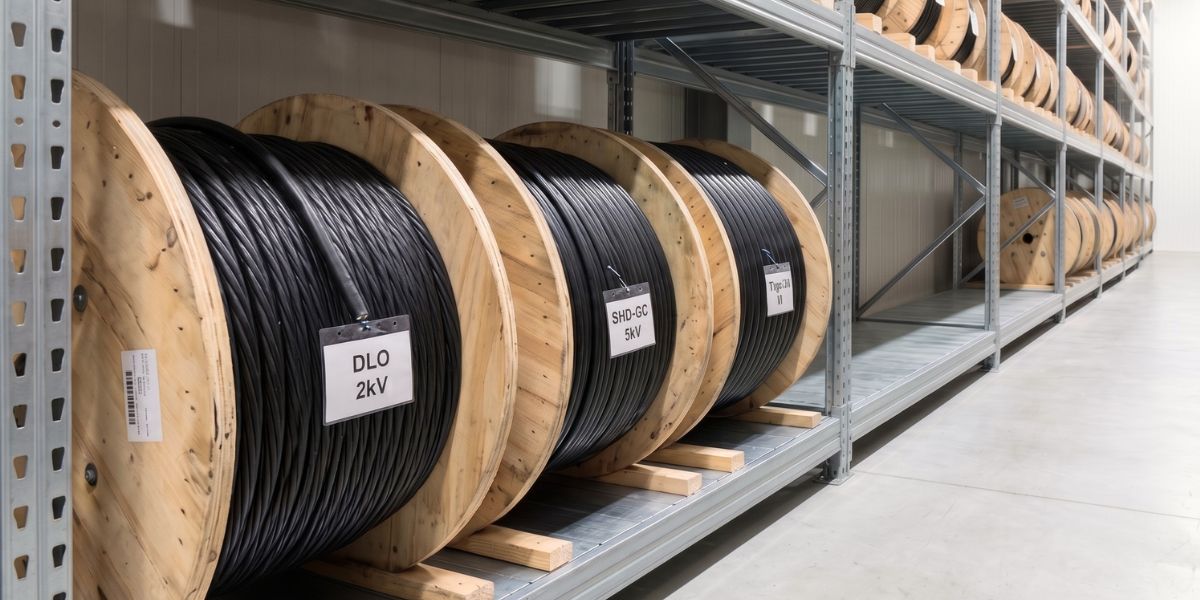
2kV | Type W*, Type G, GG-C, DLO | Heavy industrial portable power, mining trailing service, locomotive and shipyard power, oil and gas drilling, motor leads |
5kV | SHD-GC, Jumper Cable | Mining trailing cable for dredges, continuous miners, loaders, drills, conveyors, and temporary medium-voltage feeds |
15kV | Jumper Cable | Temporary medium-voltage power supply |
*Note: Heavy-duty cords like Type W, Stage Lighting (Type SC), and Welding Cable frequently carry dual listings bridging the 600V and 2kV thresholds depending on the specific application and manufacturer.
The 600V class covers more end markets than most distributors stock for. SOOW and SEOOW handle the bulk of industrial portable cord and temp power applications, but the 600V family also includes Stage Lighting cable for entertainment and production work, Bus Drop for equipment connections in manufacturing environments, and Welding Cable for welding leads.
The 2kV class is where most product differentiation happens within the mining cord family. While heavy-duty cords like Type W, Stage Lighting (Type SC), and Welding Cable frequently carry dual ratings bridging low-voltage (600V) and industrial 2kV applications, depending on the manufacturer listing, industrial specs often explicitly separate them by their application environment. Type W, Type G, GG-C, and DLO all sit in the 2kV class, but each has a distinct role. Type W is the single-conductor and basic multi-conductor option. Type G adds three or four color-coded ground conductors for three-phase AC applications. GG-C adds a ground check conductor for operations that require continuous ground monitoring. DLO is the diesel locomotive and oilfield option, built for oil and gas drilling rigs, shipyards, and motor lead applications. A request for "two-kay mining cord" could point to any of the four. The follow-up questions about grounds, shielding, and application identify which one.
At 5kV, SHD-GC is a shielded mining cable built to a different construction standard than the 2kV family. It is a different product at a different voltage class with a different standards pedigree. For the 5kV and 15kV jumper conversations specifically, the same medium-voltage logic that applies to permanent installations applies here; our 25kV medium voltage cable guide covers the upstream version of that same conversation.
Voltage class also helps determine which standards enter the conversation. A 600V cord conversation is a NEC 400 and UL 62 conversation. A 2kV or 5kV mining cord conversation adds MSHA and ICEA S-75-381 to the stack. Reading the voltage class off the spec first identifies which questions are likely to come up.
Common Jobsite Names and Product Matches
Jobsite terminology in this category does not always match UL or NEMA designations. Many terms have been used in the field for decades, and several can point to more than one product. The table below connects common jobsite names with likely product matches.
Common Jobsite Term | Likely Meaning | Product to Confirm |
|---|---|---|
"Two-kay cord" | A 2kV portable/mining cord | Type W, Type G, GG-C, or DLO, depending on grounds and shielding |
"Trailing cable" or "miner cable" | A 5kV shielded mining cord | SHD-GC |
"Yellow jacket" | A 600V cord with a yellow jacket | SEOOW |
"Welding lead" | A 600V single-conductor flexible cord | Welding Cable |
"Junior service cord" | A 300V flexible cord | SJOOW |
"Locomotive cable" or "rig cable" | A 2kV DLO cable | DLO |
"Stage cable" or "type SC" | A 600V entertainment-rated cord | Stage Lighting (Type SC) |
"Bus drop" | A 600V PVC jacketed flexible cable for equipment connections | Bus Drop |
"Jumper" or "MV jumper" | A 5/15kV temporary medium-voltage feed | Jumper Cable |
When one of these names comes up, the most useful next step is confirming the voltage and application before quoting. The three-word phrase "two-kay mining cord" can point to several different products depending on the ground configuration. "Two-kay mining cord with four grounds" points to Type G. "Two-kay mining cord with two grounds and a ground check" points to GG-C. "Two-kay mining cord, single conductor" points to Type W. The jobsite name identifies the voltage class. The follow-up questions identify the product.
Key follow-up questions include: What is the application? What is the voltage? How many conductors and grounds are required? Is shielding required? Is MSHA status required for the job? These questions clear up the most common ambiguities in the category.
How to Source Portable Cord and Mining Cable
Identifying the right product is one half of the quoting process. Sourcing it is the other half.
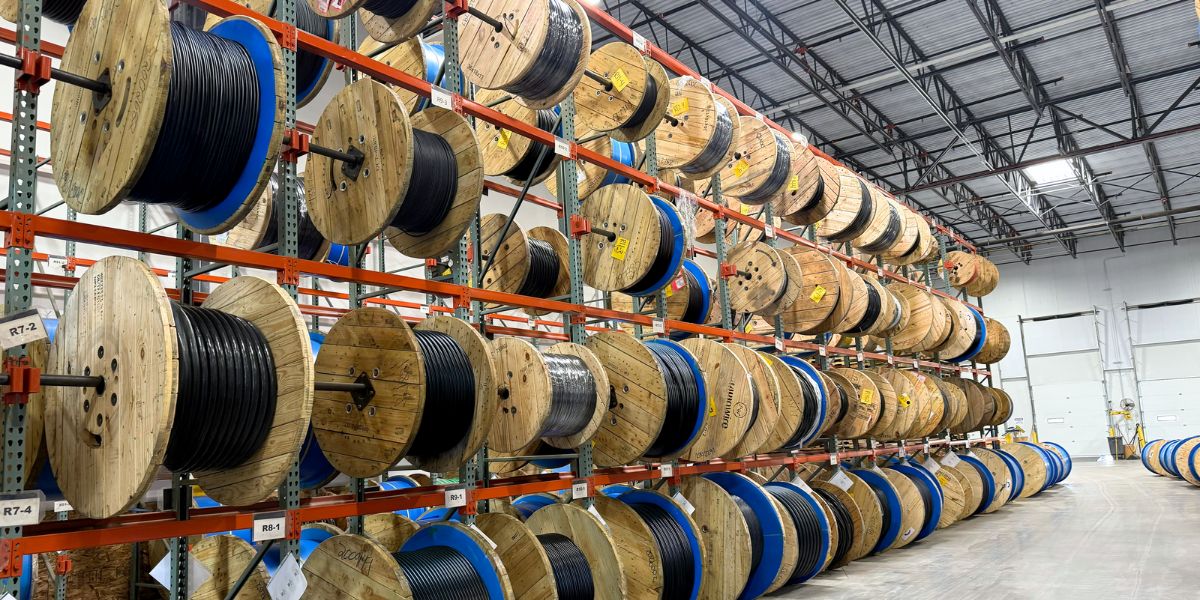
Many distributors do not stock portable cord and mining cable in depth. Demand can be unpredictable, the SKU count is large, and reels are expensive to hold at the branch level. That is where a master distributor can help: broad inventory, cut-to-length support, and access to specialized constructions without requiring every branch to carry every configuration.
DWC stocks multiple configurations across the portable cord and mining cable category, including Type W, Type G, GG-C, SHD-GC, DLO, SOOW, SEOOW, Welding Cable, Bus Drop, and related products. No cut charges, no reel minimums, and same-day shipping options out of seven cable distribution centers.
Portable Cord and Mining Cable FAQs
What is the difference between SOOW and SJOOW cable?
SOOW is a 600V extra-hard usage flexible cord. SJOOW is a 300V junior service cord rated for hard usage. The construction is genuinely different, not just the voltage rating: SJOOW uses thinner insulation and jacket walls and is built for lighter mechanical abuse. SJOOW cannot be substituted for SOOW on a spec that calls for extra-hard usage at 600V. The "S" prefix means extra-hard; the "SJ" prefix means junior service.
What is the difference between Type W, Type G, and GG-C cable?
All three are 2kV portable power cables built to ICEA S-75-381, but the ground configuration is different. Type W is single-conductor or basic multi-conductor with no dedicated equipment grounds. Type G adds three or four color-coded equipment ground conductors for three-phase AC applications. GG-C adds a ground check conductor to the Type G construction, allowing continuous ground monitoring for operations that require it, typically underground mining. Ground configuration is the key detail that identifies which cable the application calls for.
Is SHD-GC the same as Type W?
No. SHD-GC is a 5kV shielded mining trailing cable with individual conductor shielding and a ground check conductor, built for continuous miners, dredges, loaders, and conveyors. Type W is a 2kV unshielded portable cord. Different voltage class, different shielding, different standards application.
What does "MSHA Approved" actually mean for cable?
MSHA approves the electrically operated equipment for use in gassy mines and tunnels under 30 CFR Part 18, with testing requirements set in 30 CFR Part 7. Cable qualifies as a construction component within those equipment approvals. The phrase "MSHA Approved" applied to cable is industry shorthand for cable construction that meets the requirements built into MSHA-approved systems. The key question is whether the specific cable construction qualifies under the operation’s approvals, not whether the cable itself carries a standalone approval.
Can a flexible cord be used as permanent building wiring?
No. Per NEC 400.12, a flexible cord cannot substitute for fixed building wiring and cannot be concealed behind building surfaces. SOOW, Type W, and the rest of the flexible cord family are permitted under NEC Article 400 for portable applications and under NEC Article 590 for temporary installations. THHN in conduit is the product for fixed building wiring.
For portable cord and mining cable quotes, contact your DWC account manager or submit the request through fastQuote.