
What is ACSR? The Definitive Guide to Aluminum Conductor Steel Reinforced Wire
Written By: Charlie Barber
Posted February 5, 2024
Quoting the wrong conductor for a utility transmission project can stall a bid, delay a job, and erode contractor confidence in your counter. ACSR remains the dominant bare overhead conductor in North American power infrastructure for good reason: it delivers the conductivity of aluminum with the tensile strength of steel at a fraction of copper's weight and cost. For electrical distributors serving utility accounts, understanding ACSR specifications, stranding options, and code-word designations is essential to winning transmission and distribution business.
This guide covers everything a distributor salesperson needs to know about ACSR wire, from basic construction to the specification tables that help close orders.
ACSR Defined: Construction and Purpose
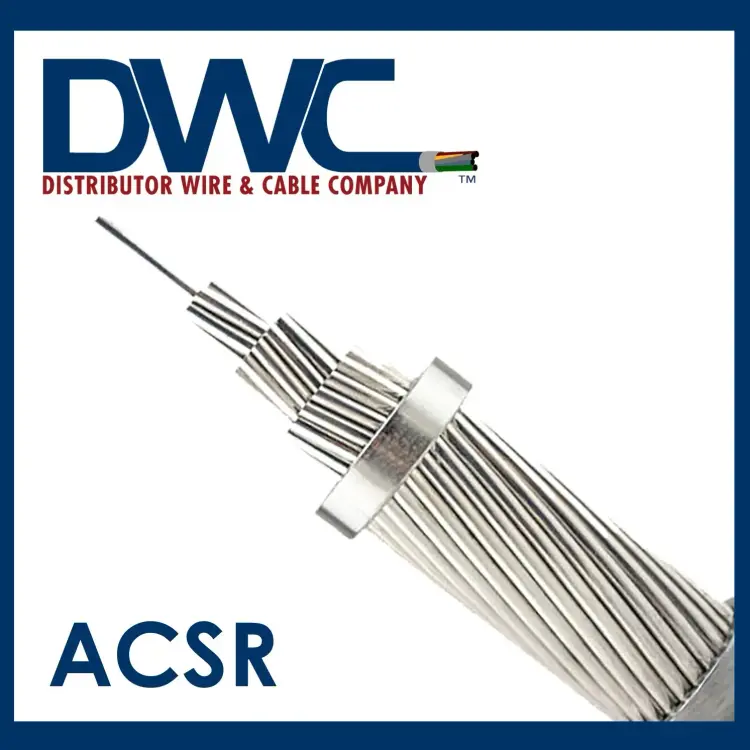
ACSR (Aluminum Conductor Steel Reinforced) is a concentrically stranded bare overhead conductor consisting of a central steel core surrounded by one or more layers of aluminum strands. The official IEC designation is A1/S1A, though North American utilities universally use the ACSR abbreviation.
The conductor's bi-metallic construction serves two distinct purposes. The outer aluminum strands, manufactured from high-purity 1350-H19 aluminum alloy with a minimum 61.2% IACS conductivity, carry the electrical current. The inner steel core provides the mechanical strength necessary to support the conductor's weight across long spans between transmission structures.
This design allows ACSR to achieve significantly longer span lengths than all-aluminum conductors while maintaining acceptable sag characteristics under load. The steel core carries most of the mechanical tension, while the aluminum strands carry the electrical load.
Why ACSR Dominates Overhead Transmission
The physics of overhead power lines create a challenging engineering problem. Conductors must carry high currents over long distances while suspended between structures that may be 1,000 feet or more apart. Every foot of span subjects the conductor to its own weight, wind loading, and ice accumulation in northern climates.
ACSR solves this problem elegantly. The galvanized steel core has a tensile strength roughly five times greater than aluminum, allowing utilities to tension the conductor to minimize sag without approaching the aluminum's mechanical limits. Meanwhile, the lower coefficient of thermal expansion of steel reduces sag variation as current load changes throughout the day.
Compared to an all-aluminum conductor (AAC) of equivalent ampacity, ACSR can span 10-15% farther between structures. For utilities building or upgrading transmission lines, this translates directly to fewer poles, less right-of-way preparation, and lower installed cost per mile.
ACSR Stranding Configurations
ACSR conductors are manufactured in standardized stranding configurations that balance electrical performance against mechanical strength. The stranding notation follows a simple convention: the first number indicates aluminum strands, the second indicates steel strands. A 26/7 conductor, for example, contains 26 aluminum strands surrounding 7 steel strands.
Higher steel-to-aluminum ratios produce conductors with greater tensile strength but slightly lower ampacity per unit weight. Lower ratios maximize current-carrying capacity at the expense of span capability.
Common ACSR Stranding Types
Stranding | Steel Content | Typical Use | Characteristics |
6/1 | Single steel wire | Distribution, short spans | Simplest construction, flexible |
26/7 | 7-strand steel core | General transmission | Balanced strength/conductivity |
30/7 | 7-strand steel core | Heavy loading areas | High strength-to-weight |
54/7 | 7-strand steel core | Long spans | Excellent sag performance |
54/19 | 19-strand steel core | Extra-high strength | Maximum tensile capacity |
The choice of stranding affects not just mechanical performance but also purchasing logistics. Most utilities standardize on one stranding type per conductor size to minimize hardware inventory, since different strandings of the same aluminum area can have different overall diameters requiring different splice and deadend fittings.
Bird Names: The North American Code Word System
North American utilities identify specific
ACSR conductor sizes
using bird-name code words—a convention dating back decades that eliminates confusion when specifying conductors over phone or radio. Each code word designates a unique combination of aluminum area and stranding.For distributors, learning the common bird names is essential because utility purchasing agents and line crews often order by code word rather than by size specification. Asking "What stranding?" when a customer orders "four reels of Raven" signals unfamiliarity with the product line.
Common ACSR Bird Names and Specifications
Code Name | Size (AWG/kcmil) | Stranding | OD (in) | Weight (lb/1000ft) | Rated Strength (lbs) |
Turkey | #6 | 6/1 | 0.198 | 24.0 | 1,190 |
Swan | #4 | 6/1 | 0.250 | 38.4 | 1,860 |
Sparrow | #2 | 6/1 | 0.316 | 60.9 | 2,850 |
Robin | #1 | 6/1 | 0.355 | 76.9 | 3,550 |
Raven | 1/0 | 6/1 | 0.398 | 96.9 | 4,380 |
Quail | 2/0 | 6/1 | 0.447 | 122 | 5,300 |
Pigeon | 3/0 | 6/1 | 0.502 | 154 | 6,620 |
Penguin | 4/0 | 6/1 | 0.563 | 194 | 8,350 |
Waxwing | 266.8 | 18/1 | 0.609 | 289 | 9,940 |
Partridge | 266.8 | 26/7 | 0.642 | 367 | 17,300 |
Linnet | 336.4 | 26/7 | 0.721 | 463 | 21,800 |
Oriole | 336.4 | 30/7 | 0.741 | 521 | 28,100 |
Dove | 556.5 | 26/7 | 0.927 | 765 | 31,500 |
Grosbeak | 636 | 26/7 | 0.990 | 873 | 35,600 |
Drake | 795 | 26/7 | 1.108 | 1,093 | 44,500 |
Tern | 795 | 45/7 | 1.063 | 1,054 | 35,500 |
Cardinal | 954 | 54/7 | 1.196 | 1,227 | 47,200 |
Curlew | 1033.5 | 54/7 | 1.245 | 1,329 | 51,100 |
Bittern | 1272 | 45/7 | 1.345 | 1,510 | 54,500 |
Falcon | 1590 | 54/19 | 1.545 | 2,042 | 87,200 |
Lapwing | 1590 | 45/7 | 1.502 | 1,792 | 67,100 |
Note: Specifications are nominal per ASTM B232. Actual values may vary by manufacturer. Utilities may use different bird names internationally.
ASTM and Industry Standards
ACSR conductors manufactured for the North American market conform to ASTM B232, which establishes requirements for materials, construction, dimensions, and testing. This standard references several supporting specifications:
ASTM B230 governs the 1350-H19 aluminum wire used for the outer strands, requiring minimum conductivity of 61.0% IACS and specified tensile strength. ASTM B498 covers the zinc-coated (galvanized) steel core wire, defining coating weight classes and mechanical properties. ASTM B502 addresses the aluminum-clad steel wire sometimes used in specialized applications.
For distributors, the key takeaway is that ACSR ordered from domestic mills to ASTM B232 will be interchangeable regardless of manufacturer. This standardization simplifies sourcing but makes service differentiation—availability, cut-to-length, delivery speed—the competitive battleground.
Steel Core Coating Classes
The steel core in ACSR is coated to prevent corrosion. ASTM B232 recognizes several coating options:
Class A (GA): Standard galvanized coating. Adequate for most environments. Most common specification.
Class B (GB): Heavier zinc coating. Specified for moderate-to-heavy corrosion environments.
Class C (GC): Heaviest zinc coating. Used in severe coastal or industrial atmospheres.
Aluminum-Clad (AW): Aluminum coating over steel. Specified where zinc may be reactive.
Zinc-5% Aluminum Mischmetal (MA): Enhanced corrosion resistance for aggressive environments.
Utilities in coastal areas or industrial corridors typically specify Class B or C coatings. Confirming the required coating class before quoting prevents costly reorders.
ACSR vs. Other Overhead Conductor Types
Electrical distributors often field questions about when to recommend ACSR versus competing conductor technologies. Understanding the tradeoffs helps match products to applications.
Conductor Comparison
Type | Full Name | Construction | Best Application | Limitations |
ACSR | Aluminum Conductor Steel Reinforced | Steel core + aluminum strands | Long transmission spans | Limited to 75°C continuous |
AAC | All Aluminum Conductor | 100% aluminum strands | Short distribution spans | Poor sag performance |
AAAC | All Aluminum Alloy Conductor | Aluminum alloy strands | Corrosive environments | Higher cost than ACSR |
ACAR | Aluminum Conductor Alloy Reinforced | Alloy core + aluminum strands | Medium spans, corrosive areas | Less common, limited availability |
ACSS | Aluminum Conductor Steel Supported | Annealed aluminum + steel | High-temperature operation | Premium pricing |
AAC offers excellent conductivity and low cost but sags excessively on long spans because aluminum cannot be highly tensioned. It remains popular for short distribution runs and bus connections.
AAAC uses heat-treated aluminum-magnesium-silicon alloy (6201-T81) that achieves higher strength than standard aluminum. Utilities specify AAAC in coastal or heavily polluted areas where the absence of a dissimilar-metal junction eliminates bimetallic corrosion concerns. The tradeoff is higher cost per ampere of capacity.
ACAR substitutes an aluminum alloy core for steel, reducing weight while maintaining reasonable strength. It finds use in moderate-span applications where corrosion is a concern but full AAAC cost is not justified.
ACSS uses fully annealed ("soft") aluminum around the steel core. Because the aluminum carries no mechanical load in ACSS, the conductor can operate continuously at temperatures up to 200°C or higher—far above ACSR's 75°C limit. Utilities use ACSS for line upgrades where higher ampacity is needed without re-conductoring with a larger size.
Operating Temperature and Ampacity
ACSR's continuous operating temperature is limited to 75°C (167°F). Above this temperature, the work-hardened aluminum strands begin to anneal (soften), permanently reducing their tensile strength. Repeated or prolonged high-temperature operation degrades the conductor and can lead to excessive sag or failure.
Ampacity ratings published by manufacturers assume specific ambient conditions, typically 25°C ambient temperature, 2 ft/sec crosswind, full sun, and emissivity of 0.5. Actual field ampacity varies with local weather, latitude, conductor age (older conductors have higher emissivity), and utility-specific safety margins.
Distributors should note that the same conductor may have significantly different ratings in utility specifications due to these varying assumptions. Always confirm the rating basis when comparing quotes or specifying replacements.
Applications Across the Grid
Transmission Lines (69kV and Above)
High-voltage transmission represents ACSR's core market. The combination of strength and conductivity enables spans exceeding 1,200 feet in favorable terrain. Common sizes range from Drake (795 kcmil) through Falcon (1590 kcmil) and larger. Bundle configurations (two or more parallel conductors per phase) are standard at 345kV and above to reduce corona discharge.
Distribution Lines (Under 69kV)
Rural electric cooperatives and municipal utilities use smaller ACSR sizes, particularly Raven (1/0), Quail (2/0), and Penguin (4/0), for primary distribution. The steel reinforcement allows longer spans between poles, reducing material and labor costs on sparsely populated routes.
River and Highway Crossings
Waterway crossings and freeway spans require maximum clearance, making sag control critical. ACSR's superior sag characteristics compared to AAC make it the default choice. Extra-high-strength strandings (54/19 or 84/19) may be specified for exceptionally long crossings.
Renewable Energy Interconnections
Wind farms and solar installations often locate in remote areas requiring new transmission to reach existing grid infrastructure. Generation-tie (gen-tie) lines typically specify ACSR for its proven reliability and availability.
DWC: Your Source for ACSR and Utility Wire
Distributor Wire & Cable maintains ready stock of popular ACSR sizes to support utility maintenance, storm restoration, and capital projects. Our supplier network provides access to the full range of conductor sizes and stranding configurations specified in the North American market.
Cut-to-Length Service: Order exactly what your utility customer needs. No minimum reel requirements. No cut charges.
Same-Day Shipping: Stock items ship the day you order when received by cutoff.
24/7 Emergency Support: Storm season does not wait for business hours. Our team stands ready to support urgent utility requirements.
Expert Assistance: Questions about bird-name equivalents, stranding options, or specifications? Our team understands overhead conductor—not just wire and cable in general.
Or log into your fastQuote account to get pricing on ACSR and other utility conductors in minutes.
For complete specifications on ACSR and other aluminum wire products, visit our Aluminum Wire & Cable product category.